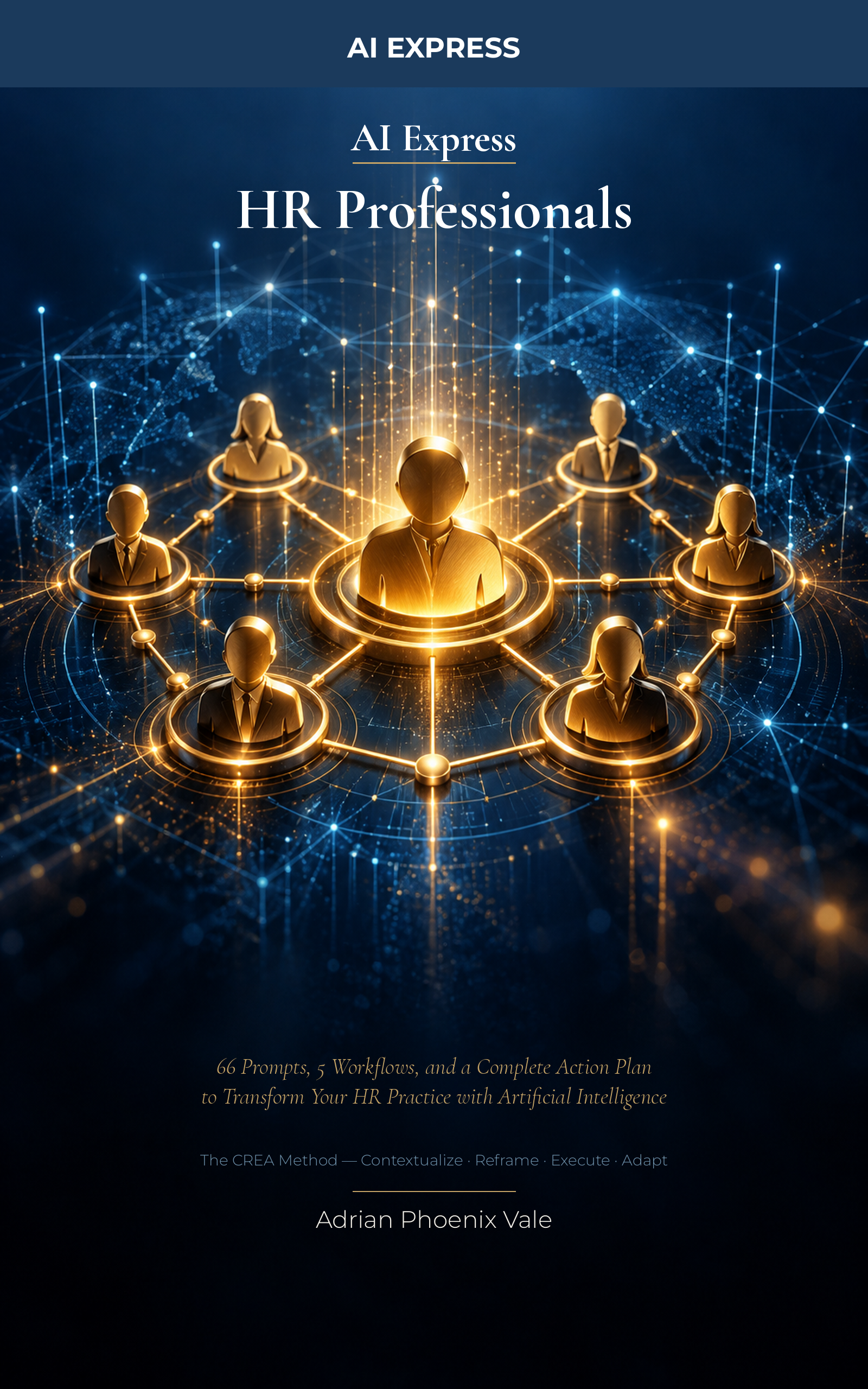
AI for HR Professionals: The Complete Guide to Transforming Human Resources in 2026
There are two types of HR departments in 2026.
The first type drowns in paperwork. Recruiters spend four hours screening resumes for a single opening. Onboarding coordinators chase signatures across seventeen forms. HR business partners copy-paste last year's performance review templates and hope managers fill them out on time. Compliance officers manually track regulatory changes across fifty states. And at the end of every quarter, the CHRO presents workforce data that's already six weeks old.
The second type operates differently. Their recruiters review a shortlist of pre-scored candidates before their morning coffee. Onboarding runs itself — personalized, compliant, and completed before Day 1. Performance reviews generate themselves from continuous feedback data. Compliance monitoring happens in real time. And the CHRO presents workforce insights that predict problems before they happen.
The difference is artificial intelligence.
Not the science fiction version. Not the "replace all humans" version. The practical, operational version that takes the most time-consuming parts of HR and handles them in minutes instead of hours.
If you're still running HR the first way, this guide will show you exactly what's possible — and how to get there.
Why 2026 Is the Inflection Point for AI in Human Resources
The convergence no one predicted
Three forces collided to make 2026 the year AI became essential — not optional — for HR professionals.
AI tools reached HR-grade reliability. Early AI outputs were impressive demos but unreliable in practice. A job description that accidentally violated the ADA. A resume screening algorithm that filtered out qualified candidates. A chatbot that gave employees wrong benefits information. Those tools weren't ready for HR. The current generation — when used with proper prompts and guardrails — produces output that HR professionals can trust, verify, and deploy.
Regulation caught up. NYC Local Law 144 requiring bias audits on automated employment decision tools. The EEOC's guidance on AI and Title VII. Illinois's Artificial Intelligence Video Interview Act. Colorado's AI Act. The regulatory landscape didn't just catch up — it leapfrogged ahead. HR professionals who don't understand these frameworks are exposed. Those who do have a competitive advantage.
The talent market demands speed. The average time-to-hire in 2026 is 44 days. Top candidates are off the market in 10. Companies still running manual recruitment processes aren't just slow — they're invisible to the best talent. AI-powered recruitment doesn't just match the speed candidates expect. It exceeds it.
The numbers that matter
The data tells a clear story:
- Organizations using AI in recruitment report a 35-40% reduction in time-to-hire
- AI-powered onboarding programs show 25% higher new-hire retention at the 12-month mark
- Companies using AI for compensation analysis identify pay equity gaps 60% faster than manual audits
- HR teams using AI for compliance documentation spend 70% less time on regulatory reporting
These aren't projections. They're results from organizations that have already made the transition.
The Seven Domains Where AI Transforms HR
1. Talent acquisition and recruitment
Recruitment is where most HR teams start their AI journey — and for good reason. The recruitment process is repetitive, data-heavy, and time-sensitive. All three characteristics make it ideal for AI augmentation.
Job description optimization. AI can analyze thousands of high-performing job postings to identify the language patterns that attract the most qualified applicants. It can flag gendered language, ensure ADA compliance, and optimize for job board search algorithms — in seconds.
Resume screening at scale. A single job posting generates an average of 250 resumes. Screening them manually takes 23 hours. AI-powered screening can evaluate all 250 against your specific criteria in under 10 minutes — scoring for skills match, experience relevance, and cultural alignment indicators.
Interview preparation. AI generates structured interview scorecards tailored to each role, ensuring every interviewer evaluates the same competencies with the same criteria. This isn't just more efficient — it's more legally defensible.
Candidate communication. From initial outreach to rejection notifications, AI ensures every candidate receives timely, personalized communication — without requiring a recruiter to draft 200 individual emails.
2. Employee onboarding
The first 90 days determine whether a new hire stays or leaves. Yet most onboarding programs are a disconnected series of forms, videos, and meetings that leave new employees confused and disengaged.
AI-powered onboarding changes the equation:
- Personalized learning paths based on role, department, experience level, and learning style
- Automated document collection and verification — I-9s, tax forms, NDAs, benefits enrollment — with intelligent reminders and error detection
- Smart scheduling that coordinates orientation sessions, manager meetings, mentor introductions, and training modules across multiple calendars
- Progress tracking that alerts HR when a new hire falls behind and identifies the specific intervention needed
3. Performance management
The annual performance review is universally hated — by managers who write them, employees who receive them, and HR teams who administer them. AI doesn't eliminate the human judgment at the core of performance evaluation. It eliminates the busywork around it.
Continuous feedback synthesis. AI aggregates feedback from multiple sources — peer reviews, project outcomes, 1:1 notes, goal tracking systems — into a coherent narrative that serves as the foundation for a performance conversation.
Review draft generation. Based on documented achievements, goals, and feedback, AI generates a first draft that managers can review, edit, and personalize. This reduces the average time per review from 45 minutes to 15 minutes — without sacrificing quality.
Performance Improvement Plan (PIP) documentation. When performance issues require formal intervention, AI ensures the documentation is specific, measurable, legally compliant, and aligned with company policy.
4. Compensation and benefits analysis
Pay equity isn't just an ethical imperative — it's a legal requirement. And manual compensation analysis is slow, error-prone, and typically outdated by the time it's complete.
AI-powered compensation analysis provides:
- Real-time market benchmarking against industry and geographic data
- Internal equity analysis that identifies pay gaps across gender, race, age, and other protected categories
- Total compensation modeling that factors in benefits, equity, bonuses, and perks
- Scenario planning for budget impacts of proposed salary adjustments, promotions, and new-hire offers
5. Compliance and risk management
Employment law is complex, constantly evolving, and unforgiving of mistakes. HR professionals are expected to track regulations across federal, state, and local jurisdictions — often with no dedicated legal support.
AI serves as a force multiplier for compliance:
- Regulatory monitoring that flags relevant changes in employment law across all jurisdictions where the company operates
- Policy review and updates that identify gaps between current company policies and new regulatory requirements
- Audit preparation that organizes documentation, identifies missing records, and generates compliance reports
- Training content that translates complex legal requirements into accessible employee communications
Critical compliance frameworks covered: Title VII, ADA, ADEA, FMLA, EEOC AI Guidance, NYC Local Law 144, Illinois AIPA, Colorado AI Act, CCPA, and OFCCP requirements.
6. Workforce planning and analytics
HR has always had data. What it hasn't had is the ability to turn that data into actionable intelligence at the speed business requires.
AI-powered workforce analytics enables:
- Turnover prediction that identifies flight risks before they submit their resignation
- Skills gap analysis that maps current capabilities against future business needs
- Succession planning that identifies internal candidates for critical roles based on performance, potential, and development trajectory
- Headcount modeling that forecasts hiring needs based on business growth projections, attrition rates, and market conditions
7. Employee relations and engagement
The most underappreciated application of AI in HR is in the daily work of employee relations — the conversations, investigations, and interventions that keep an organization functioning.
- Sentiment analysis from engagement surveys, exit interviews, and internal communications that identifies emerging issues before they become crises
- Investigation documentation that ensures consistency, thoroughness, and legal compliance
- Internal communications that are personalized, timely, and tailored to different employee populations
- Change management content that addresses employee concerns proactively
The CREA Method: A Framework for Any HR AI Task
The biggest mistake HR professionals make with AI is treating it like a search engine. You type a question, you get an answer, you move on. That approach produces mediocre results.
The CREA Method — Contextualize, Reframe, Execute, Adapt — is a systematic framework that turns any AI tool into an expert-level HR assistant.
Contextualize. Before you write a prompt, define the context. What role is the AI playing? What's the business situation? What constraints exist? What outcome do you need? A prompt that says "write a job description for a software engineer" produces a generic result. A prompt that contextualizes — industry, company stage, team dynamics, compensation philosophy, compliance requirements — produces something you can actually use.
Reframe. Challenge your first instinct. If you're using AI to screen resumes, reframe: could it also identify candidates you're overlooking? If you're using it to write performance reviews, reframe: could it identify patterns across the team that suggest a systemic issue? The most valuable AI applications are often one reframe away from the obvious one.
Execute. Run the prompt. Review the output critically. HR output requires human review — always. Check for bias. Check for compliance. Check for accuracy. Check for tone. AI is your first draft, not your final answer.
Adapt. Refine based on results. The best HR AI users build prompt libraries that improve over time — tested, refined, and validated against real outcomes.
Compliance: The Non-Negotiable Foundation
Using AI in HR without understanding the compliance landscape is like performing surgery without studying anatomy. You might get lucky. But the downside is catastrophic.
The frameworks every HR professional must know
Title VII of the Civil Rights Act. AI tools that produce disparate impact on protected classes violate Title VII — regardless of whether the bias was intentional. If your resume screening tool disproportionately filters out candidates of a particular race, gender, or national origin, you're liable.
The ADA. AI-powered assessments must provide reasonable accommodations. If your video interview AI penalizes candidates with speech impediments or physical disabilities, you're in violation.
The EEOC's AI Guidance. The EEOC has made clear that employers are responsible for the AI tools they use — even if a third-party vendor built them. "The algorithm did it" is not a defense.
NYC Local Law 144. Any employer using automated employment decision tools in New York City must conduct annual bias audits and provide notice to candidates. This law has set the template for similar legislation nationwide.
Illinois AIPA. Employers using AI to analyze video interviews must notify candidates and obtain consent. The analysis must be explained in plain language.
Colorado AI Act. Requires developers and deployers of high-risk AI systems to exercise reasonable care to prevent algorithmic discrimination.
Building compliance into your AI workflow
Compliance isn't a final check. It's a design principle. The most effective HR AI implementations build compliance into every step:
- Vendor evaluation — Before adopting any AI tool, audit it for bias, transparency, and regulatory alignment
- Prompt engineering — Design prompts that explicitly include compliance requirements
- Output review — Every AI-generated employment decision must be reviewed by a qualified human
- Documentation — Maintain records of AI tool usage, decisions made, and human oversight applied
- Regular auditing — Conduct quarterly bias audits on all AI tools used in employment decisions
Getting Started: The 7-Day Implementation Plan
You don't need a six-month transformation initiative. You need seven focused days.
Day 1-2: Audit. Map every HR process that involves repetitive, data-heavy, or time-sensitive work. These are your AI opportunities.
Day 3: Prioritize. Pick the one process where AI will deliver the most impact with the least risk. For most teams, that's recruitment or onboarding.
Day 4-5: Build. Develop your first set of AI prompts using the CREA Method. Test them against real scenarios. Refine until the output meets your standards.
Day 6: Compliance check. Review your AI implementation against every applicable regulation. Document your compliance approach.
Day 7: Deploy. Launch your first AI-powered process. Monitor results. Gather feedback. Iterate.
Who This Is For — and Who It's Not
This is for you if:
- You're an HR generalist who handles everything from recruiting to compliance and needs to do it faster
- You're a CHRO building the business case for AI adoption across your HR function
- You're a recruiter who wants to fill positions in days instead of months
- You're a compensation analyst who needs to run pay equity audits without hiring a consulting firm
- You're an HR business partner who wants to become the strategic advisor your business leaders actually listen to
This isn't for you if:
- You want AI to make employment decisions without human oversight (it shouldn't)
- You're looking to cut your HR headcount by replacing people with algorithms (that's not how it works)
- You're not willing to learn a new skill set (AI proficiency is now a core HR competency)
The Bottom Line
The HR profession is at a crossroads. The administrative burden is increasing. The regulatory complexity is multiplying. The expectations from business leaders are escalating. And the talent market is more competitive than ever.
AI doesn't solve all of these problems. But it solves the ones that are burying you in busywork — freeing you to do the strategic, human work that actually moves the business forward.
AI Express — HR Professionals is the most comprehensive, practical AI guide written specifically for the HR profession. 66 prompts. 5 workflows. 5 case studies. 40 chapters. 451 pages. Full compliance framework. Zero fluff.
The HR professionals who master AI now will define the future of work. The question is whether you'll be one of them.
Also read:
- AI-powered recruitment: how to screen 250 resumes in 10 minutes
- HR compliance and AI: navigating Title VII, EEOC, and Local Law 144
- Employee retention strategies that actually work in 2026
- How to build a data-driven compensation strategy with AI
Get the Complete System
You've read the overview. Now get the full system — 66 prompts you can copy and paste today, 5 workflows you can implement this week, and a compliance framework that keeps you protected.