Book Description & Blurb Templates
Your book description is your #1 sales tool on Amazon. Most authors waste it. This guide gives you 24 genre-specific blurb templates, power word lists, Amazon HTML formatting, and a revision checklist to turn your description into a conversion machine.
💡 What you'll learn
How to write book descriptions and blurbs that convert browsers into buyers — with 24 ready-to-use fill-in-the-blank templates covering every major fiction and nonfiction genre.
Description
Your cover gets the click. Your description gets the sale. And right now, your description is probably losing you readers.
Most self-published authors treat their book description as an afterthought — a quick plot summary dashed off five minutes before hitting "Publish." But on Amazon, your description is the single most important piece of sales copy you will ever write. It is the last thing a reader sees before deciding to buy or bounce. A great description converts 10-15% of browsers into buyers. A weak one converts 1-2%. On the same book.
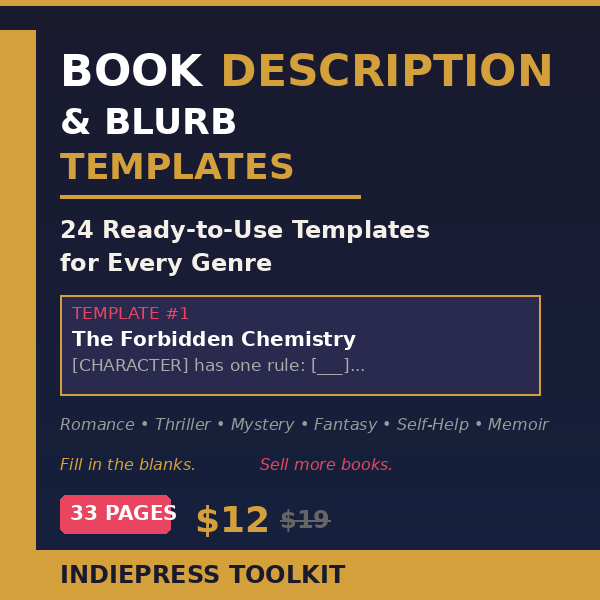
Book Description & Blurb Templates eliminates the guesswork. Built by an indie author with 100+ books published across 15+ languages, this 33-page guide gives you a proven system for writing descriptions that sell — in any genre, for any book.
- ✍️ 24 fill-in-the-blank templates — genre-specific blurb structures for fiction (romance, thriller, fantasy, mystery, horror, sci-fi, literary, historical, YA) and nonfiction (self-help, business, health, memoir, how-to) — just fill in your details and publish
- 🔥 Power word lists — the specific emotional trigger words that make readers feel urgency, curiosity, and desire — organized by genre and tone
- 💻 Amazon HTML formatting guide — bold text, italic, line breaks, and bullet points that actually render correctly on KDP — with copy-paste code snippets
- ✅ Revision checklist — a 15-point quality check to run on every description before publishing, covering hooks, pacing, keywords, tone, and call-to-action
- 📐 Anatomy of a converting blurb — the structural breakdown of why the best descriptions work, with before-and-after examples
Stop guessing. Start converting.