How Solo Practitioners Compete with Big Firms Using AI: The Small Law Firm's Guide to Artificial Intelligence
A solo practitioner in a home office competing against a 200-attorney firm used to be a mismatch. The firm had associates for research, paralegals for document preparation, marketing departments for business development, and IT teams for technology. The solo had themselves — and maybe a part-time assistant.
AI changes the competitive equation fundamentally.
A solo attorney with AI tools can now research case law with the thoroughness of a team of associates. Draft contracts with the speed of a dedicated transactions group. Generate client communications with the polish of a firm with a marketing department. And manage practice operations with the efficiency of a firm with dedicated administrative staff.
The solo practitioner's natural advantages — lower overhead, faster decision-making, deeper client relationships, and flexibility — are amplified by AI rather than offset by limited resources. The result is a practice model that's not just viable but genuinely competitive with firms that have ten times the headcount.
The Solo Practitioner's AI Advantage
Speed without hierarchy
When a big firm client needs a research memorandum, the request flows from partner to senior associate to junior associate, back up through review, and eventually to the client. This chain adds days — sometimes weeks — to turnaround time.
A solo attorney with AI produces the same research memorandum in a fraction of the time — because there's no hierarchy to navigate. The attorney formulates the research question, generates AI-assisted analysis, verifies citations, adds professional judgment, and delivers. Same quality. Faster turnaround. Lower cost.
Depth without overhead
A solo attorney's biggest competitive disadvantage has always been bandwidth. There are only so many hours in a day, and every hour spent on research is an hour not spent on client development, court appearances, or strategic work.
AI extends bandwidth dramatically. Research that took six hours takes two. Contract review that took three hours takes one. Client communications that took 45 minutes take 15. The solo attorney reclaims hours every day — hours that can be invested in the high-value activities that build a practice.
Expertise without specialization staff
A corporate attorney who occasionally handles an employment matter. A family law attorney who needs to understand a tax issue. A litigator who takes on a contract dispute in an unfamiliar area. Solo practitioners frequently need expertise beyond their core specialization.
AI provides on-demand expertise support — summarizing relevant law, identifying key issues, and generating initial analysis in areas where the attorney may not have deep experience. This doesn't replace the need for specialized knowledge, but it bridges the gap between encountering a novel issue and understanding it well enough to serve the client competently.
AI Applications for Solo Practice
Client intake and management
Automated intake forms. AI generates comprehensive intake questionnaires tailored to your practice areas — capturing the information you need for conflict checks, case evaluation, and engagement letters.
Conflict checks. AI searches your records for potential conflicts based on names, entities, and related matters — a task that grows more complex as your practice matures and your client list grows.
Engagement letters. AI drafts engagement letters customized to the specific matter type, fee arrangement, and scope of representation — ensuring your retainer agreements are comprehensive and enforceable.
Client communications. Status updates, case summaries, deadline reminders, and billing explanations — AI generates professional communications that keep clients informed without consuming your evening.
Legal research and analysis
This is where AI delivers its greatest solo-practice value. With AI, you can:
- Research a question of law with the thoroughness of a three-attorney team
- Generate research memoranda in a fraction of the time
- Conduct multi-jurisdictional analysis without hiring a research service
- Stay current with regulatory changes across your practice areas
- Prepare for hearings and depositions with comprehensive case analysis
The critical discipline: Verify every citation. Without a supervising partner to catch errors, the solo practitioner bears full responsibility for every word submitted to a court. The verification step is non-negotiable.
Document drafting
Pleadings. Motions, briefs, complaints, answers — AI generates first drafts that follow local rules and court preferences. The solo attorney who once spent an entire day drafting a summary judgment motion now has a reviewable draft in an hour.
Contracts. AI generates agreement drafts for routine transactions — NDAs, service agreements, consulting agreements, employment contracts — with the attorney customizing for the specific deal. This allows solo practitioners to offer transactional services that were previously cost-prohibitive without associate support.
Discovery. Discovery requests and responses are formulaic but time-consuming. AI generates interrogatories, requests for production, and responses — with the attorney adding strategy and substance.
Practice marketing and business development
Content marketing. AI generates blog posts, client alerts, newsletter content, and social media posts that demonstrate expertise and attract potential clients. A consistent content presence — once possible only with a marketing department — is now achievable for a solo practitioner spending an hour per week.
SEO-optimized web content. AI creates practice-area pages, FAQ sections, and informational content that improves search engine visibility — the most cost-effective client acquisition channel for solo practitioners.
Presentation materials. CLE presentations, seminar handouts, and speaking engagement materials — AI helps the solo practitioner build a reputation as a subject matter expert.
Practice operations
Time tracking and billing. AI generates detailed billing narratives from brief notes — transforming "research re: Smith matter" into a comprehensive description that clients understand and appreciate.
Calendar and deadline management. AI helps create deadline tracking systems with built-in alerts for statute of limitations, filing deadlines, and client communication cadences.
Knowledge management. As your practice grows, AI helps organize your accumulated work product — briefs, memoranda, contracts, templates — into a searchable library that prevents you from reinventing the wheel.
The Economics of AI for Solo Practice
Cost comparison
Traditional solo practice costs for a complex research project:
- 6-8 hours of attorney time
- Westlaw/Lexis subscription costs
- Potential research service fees
- Total: significant time investment and direct costs
AI-augmented solo practice costs for the same project:
- 2-3 hours of attorney time (including verification)
- AI tool subscription (a fraction of traditional research tool costs)
- Total: dramatically reduced time and potentially lower direct costs
Revenue impact
The time saved through AI translates directly into revenue opportunities:
- More matters. With each matter taking less time, you can handle a larger caseload without sacrificing quality.
- Better matters. The time freed from routine tasks can be invested in business development — attracting higher-value clients and matters.
- Competitive pricing. Lower costs allow competitive pricing that wins clients who might otherwise choose a larger firm.
- Alternative fees. AI makes flat-fee arrangements more profitable — you know the work will take less time, so fixed pricing becomes a competitive advantage rather than a risk.
Building Your Solo AI Practice
Month 1: Foundation
- Select your AI tools (prioritize legal-specific options with confidentiality protections)
- Develop your first 10 prompt templates for your most common tasks
- Establish your citation verification workflow
- Update your engagement letter with AI disclosure language
Month 2: Expansion
- Build prompt templates for all major practice areas
- Create a client communication template library
- Start AI-powered content marketing (one blog post per week)
- Develop your contract drafting workflow
Month 3: Optimization
- Analyze time savings and adjust pricing strategy
- Build your clause library for contract work
- Refine prompts based on results
- Expand marketing content to social media and newsletters
Ongoing
- Stay current with AI developments and ethics guidance
- Refine your prompt library continuously
- Track ROI and adjust your practice model
- Share best practices with your professional network
Ethics for Solo Practitioners
Solo practitioners face unique ethical challenges with AI because there's no second set of eyes. The supervising partner who catches the hallucinated citation at a big firm doesn't exist in solo practice. You are the first and last line of defense.
Build redundancy into your process:
- Never submit AI-generated content without a complete citation check
- Let AI-generated drafts sit overnight before final review when possible
- Use multiple AI tools for critical research — if two tools disagree, investigate
- Maintain a checklist for every major document type — and use it every time
- Consider peer review arrangements with other solo practitioners for high-stakes matters
The Bottom Line
The solo practitioner with AI isn't a solo practitioner with a clever tool. They're a one-person firm with the research capability of an associate pool, the drafting speed of a transactions team, and the marketing presence of a firm with a business development department.
The overhead stays low. The flexibility stays high. The client relationships stay deep. And the work product is competitive with firms of any size.
AI doesn't level the playing field between solo practitioners and big firms. It tilts it.
Also read:
- AI for lawyers: the complete guide to transforming your practice in 2026
- AI-powered legal research: how to cut case analysis time by 70%
- AI contract review and drafting: the practical guide for law firms
- ABA Model Rules and AI: ethics compliance for attorneys
Your AI-Powered Practice Starts Here
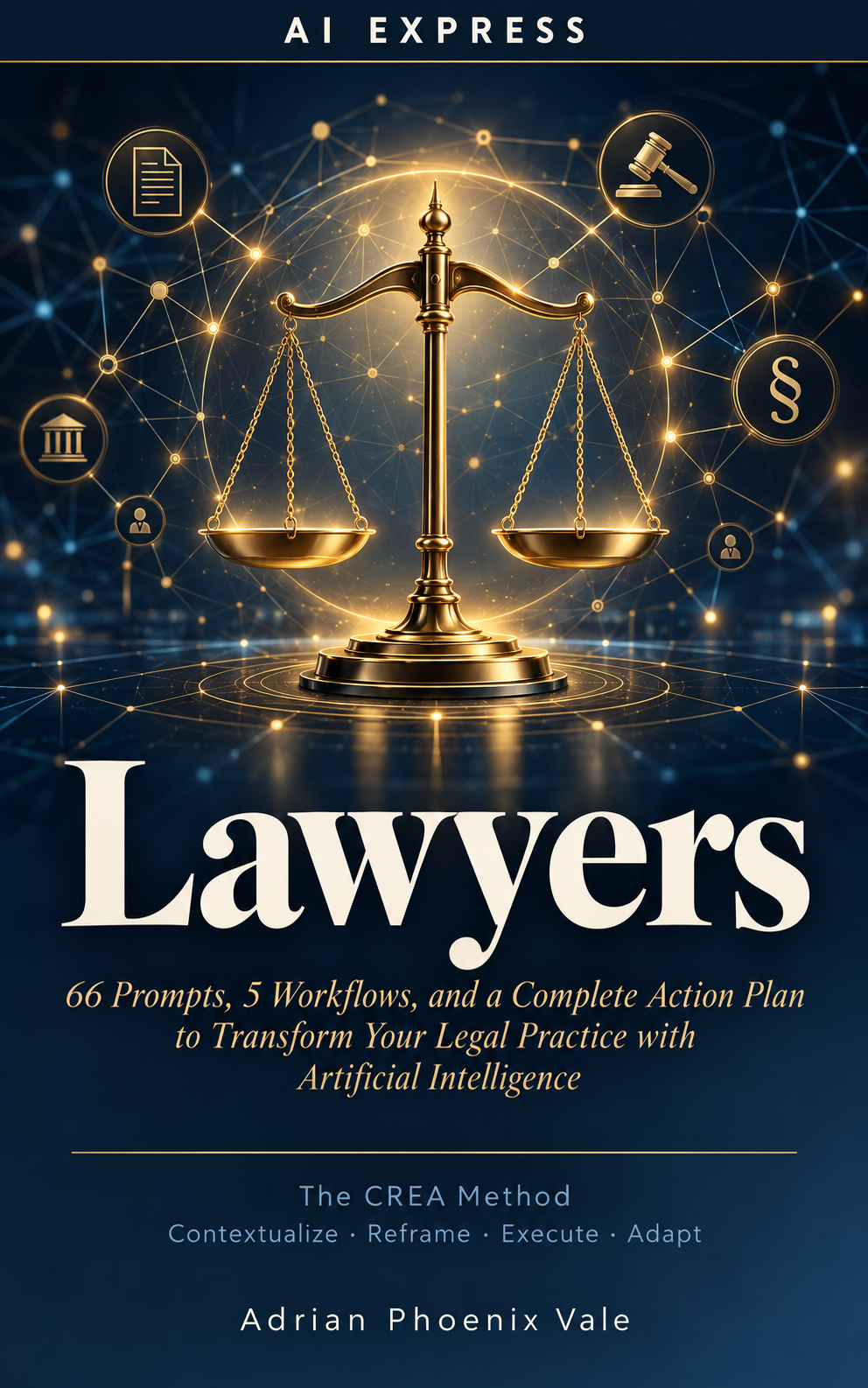
AI Express — Lawyers was designed for attorneys at every level — from solo practitioners to partners at national firms. 66 prompts. 5 workflows. 5 case studies. 628 pages. Full ethics framework. The complete system to transform your legal practice.