AI for Lawyers: The Complete Guide to Transforming Your Legal Practice in 2026
The legal profession is at an inflection point.
A solo practitioner in Denver is using AI to research case law, draft motions, and prepare trial briefs — producing work product that would have required a team of three associates five years ago. A mid-size litigation firm in Atlanta has cut document review costs by 70% using AI-powered e-discovery. A corporate law department in New York generates first drafts of standard contracts in minutes instead of hours.
Meanwhile, a partner at a prestigious firm was sanctioned by a federal judge for submitting a brief containing AI-generated case citations that didn't exist. A solo attorney lost a client's trust by sending a demand letter with AI hallucinations embedded in the legal analysis. And a legal tech vendor's AI tool was found to systematically misinterpret certain regulatory frameworks, exposing firms to malpractice liability.
AI in legal practice is not optional in 2026. But it's also not safe to use without understanding how it works, where it fails, and what your ethical obligations are when you use it.
This guide covers all of it — the opportunities, the risks, the ethics, and the practical implementation.
The Six Practice Domains Where AI Delivers
1. Legal research
Legal research is the foundational task of every law practice — and the one where AI delivers the most dramatic efficiency gains.
What AI does well:
- Case law analysis. AI processes vast databases of judicial opinions to identify relevant precedent, distinguish favorable from unfavorable authority, and map the evolution of legal doctrines across jurisdictions.
- Statutory and regulatory research. AI tracks regulatory changes across federal, state, and local jurisdictions — particularly valuable for practices in heavily regulated areas like healthcare, financial services, and employment law.
- Synthesis and summarization. AI distills lengthy opinions, regulations, and secondary sources into actionable summaries — capturing holdings, reasoning, and implications.
- Research memorandum drafting. AI generates structured research memoranda with issue statements, rules of law, analysis, and conclusions — in a fraction of the time manual drafting requires.
The critical warning: AI can and does generate plausible-sounding citations to cases that don't exist. Every citation must be verified through traditional legal databases. No exceptions. The attorney who submits an unverified AI-generated citation faces sanctions, malpractice exposure, and reputational damage that no efficiency gain is worth.
2. Contract drafting and review
Contract work is repetitive, detail-intensive, and time-consuming — which makes it ideal for AI augmentation.
Contract drafting. AI generates first drafts of standard agreements — NDAs, service agreements, employment contracts, lease agreements — based on your specifications. The attorney reviews, customizes, and refines. The first draft takes minutes instead of hours.
Contract review. AI analyzes incoming contracts against your standard positions, flagging deviations from acceptable terms, identifying missing provisions, and highlighting potentially problematic language. A contract review that took two hours takes twenty minutes.
Clause libraries. AI helps build and maintain clause libraries — collections of preferred language for common provisions, organized by contract type and negotiating position. When drafting, AI pulls from your library, ensuring consistency across the firm.
Redlining and comparison. AI compares contract versions, identifies changes, and generates redline summaries that highlight substantive modifications versus stylistic changes.
3. Litigation support
From pre-suit investigation through trial preparation, AI accelerates every phase of litigation.
Pleading drafting. AI generates first drafts of complaints, answers, motions, and briefs — structured according to local rules and formatted for the specific court. The attorney provides the legal theory and factual framework; AI handles the structure and boilerplate.
E-discovery. This is where AI delivers the most dramatic cost savings. AI-powered document review can process millions of documents, identifying responsive and privileged materials with accuracy rates that match or exceed human review — at a fraction of the cost and time.
Deposition preparation. AI analyzes witness statements, prior testimony, and relevant documents to generate deposition outlines with suggested questions organized by topic and strategic objective.
Trial preparation. AI assists with jury instruction research, exhibit organization, witness examination outlines, and opening/closing argument frameworks.
4. Client management
Client communications. AI drafts status updates, case summaries, and engagement letters — ensuring every client receives timely, professional communication without consuming hours of attorney time.
Intake and onboarding. AI streamlines the client intake process — generating conflict checks, engagement letters, and initial case assessments that accelerate the onboarding timeline.
Billing narrative improvement. AI generates clear, detailed billing narratives that clients understand — reducing billing disputes and improving realization rates.
5. Practice operations
Knowledge management. AI organizes and indexes the firm's accumulated work product — briefs, memoranda, contracts, opinions — creating a searchable knowledge base that prevents attorneys from reinventing the wheel.
Marketing content. AI generates blog posts, client alerts, newsletter content, and social media posts that demonstrate the firm's expertise — maintaining a consistent publishing cadence without consuming billable hours.
CLE preparation. AI helps attorneys prepare for continuing legal education presentations — structuring content, creating slides, and generating handout materials.
6. Specialized practice areas
Corporate. Due diligence analysis, board resolution drafting, securities compliance review, M&A documentation.
Real estate. Title review, lease analysis, zoning research, closing document preparation.
Intellectual property. Prior art research, patent claim analysis, trademark clearance, licensing agreement drafting.
Employment. Handbook review, policy drafting, compliance audits, investigation documentation.
Immigration. Visa petition preparation, country condition research, case law updates, client communication in multiple languages.
Tax. Tax research memoranda, planning scenario analysis, compliance documentation, IRS correspondence.
Ethics and Professional Responsibility
ABA Model Rules and AI
The American Bar Association has addressed AI use through interpretations of existing Model Rules. Every attorney using AI must understand these obligations:
Rule 1.1 — Competence. An attorney must provide competent representation, which includes understanding the technology they use. Using AI without understanding its capabilities, limitations, and failure modes violates the duty of competence.
Rule 1.6 — Confidentiality. Client information entered into AI tools may be disclosed to the tool provider — a potential confidentiality violation. Attorneys must understand how AI tools process, store, and potentially use the data they receive. Never input client-identifiable information into a general-purpose AI tool without appropriate safeguards.
Rule 5.3 — Supervision of non-lawyers. AI is not a lawyer. Output generated by AI must be supervised with the same diligence applied to work by paralegals and law clerks. The attorney is responsible for every word submitted to a court or delivered to a client.
Rule 1.4 — Communication. Some jurisdictions require disclosure to clients that AI tools are being used in their representation. Know your jurisdiction's requirements.
Rule 3.3 — Candor toward the tribunal. Submitting AI-generated citations without verification violates the duty of candor. Every citation must be independently verified before submission.
State bar ethics opinions
Multiple state bars have issued formal ethics opinions on AI:
- California requires attorneys to maintain competence in AI tools they use and to supervise AI output as they would a junior associate's work.
- New York emphasizes confidentiality obligations when using AI tools and recommends disclosure to clients.
- Florida addresses the duty to verify AI-generated legal research and the obligation to understand AI limitations.
- Texas focuses on the intersection of AI use and billing practices — attorneys cannot bill for reviewing AI-generated work at the same rate as original work without disclosure.
Building ethics into your AI workflow
- Never input client-identifiable information into non-approved tools
- Verify every citation before submission — no exceptions
- Review every output with the same scrutiny you'd apply to a junior associate's draft
- Disclose AI use as required by your jurisdiction
- Document your process — what tools you used, what review you conducted
- Stay current — ethics opinions on AI are evolving rapidly
The CREA Method for Legal Practice
Contextualize. Legal AI prompts require more context than any other profession. Jurisdiction. Practice area. Court level. Applicable rules. Specific legal issues. The standard of review. The procedural posture. The more context you provide, the more useful the output.
Reframe. Don't just ask AI to draft a motion. Ask it to identify the strongest arguments. Then ask it to anticipate the opposition's response. Then ask it to draft the reply to that response. Each reframe deepens the analysis.
Execute. Run the prompt. Review with the eye of a practicing attorney. Check citations. Check reasoning. Check whether the analysis actually addresses your specific facts. AI produces competent first drafts — not filed-ready documents.
Adapt. Build a prompt library organized by practice area, document type, and court. Refine each prompt based on results. The best legal AI users have libraries of hundreds of tested prompts that consistently produce high-quality starting points.
Getting Started: The 30-Day Plan
Week 1: Research. Start with legal research — the highest-value, lowest-risk application. Use AI to find relevant cases, summarize holdings, and draft research memoranda. Verify every citation.
Week 2: Drafting. Move to document drafting — standard contracts, routine motions, client communications. Compare AI drafts to your manual work. Identify where AI adds value and where it falls short.
Week 3: Analysis. Use AI for analytical tasks — contract review, deposition preparation, case assessment. These tasks require more sophisticated prompting and more careful review.
Week 4: Integration. Build AI into your daily workflow. Create prompt libraries. Establish review protocols. Train your team. Measure the efficiency gains.
The Bottom Line
AI doesn't replace lawyers. The complexity, judgment, advocacy, and ethical obligations of legal practice are irreducibly human. But AI transforms the economics of legal work — making every attorney more productive, every deliverable more thorough, and every client better served.
The attorneys who master AI in 2026 won't just work faster. They'll compete more effectively, serve clients more comprehensively, and build more sustainable practices — whether they're solo practitioners or partners at the largest firms.
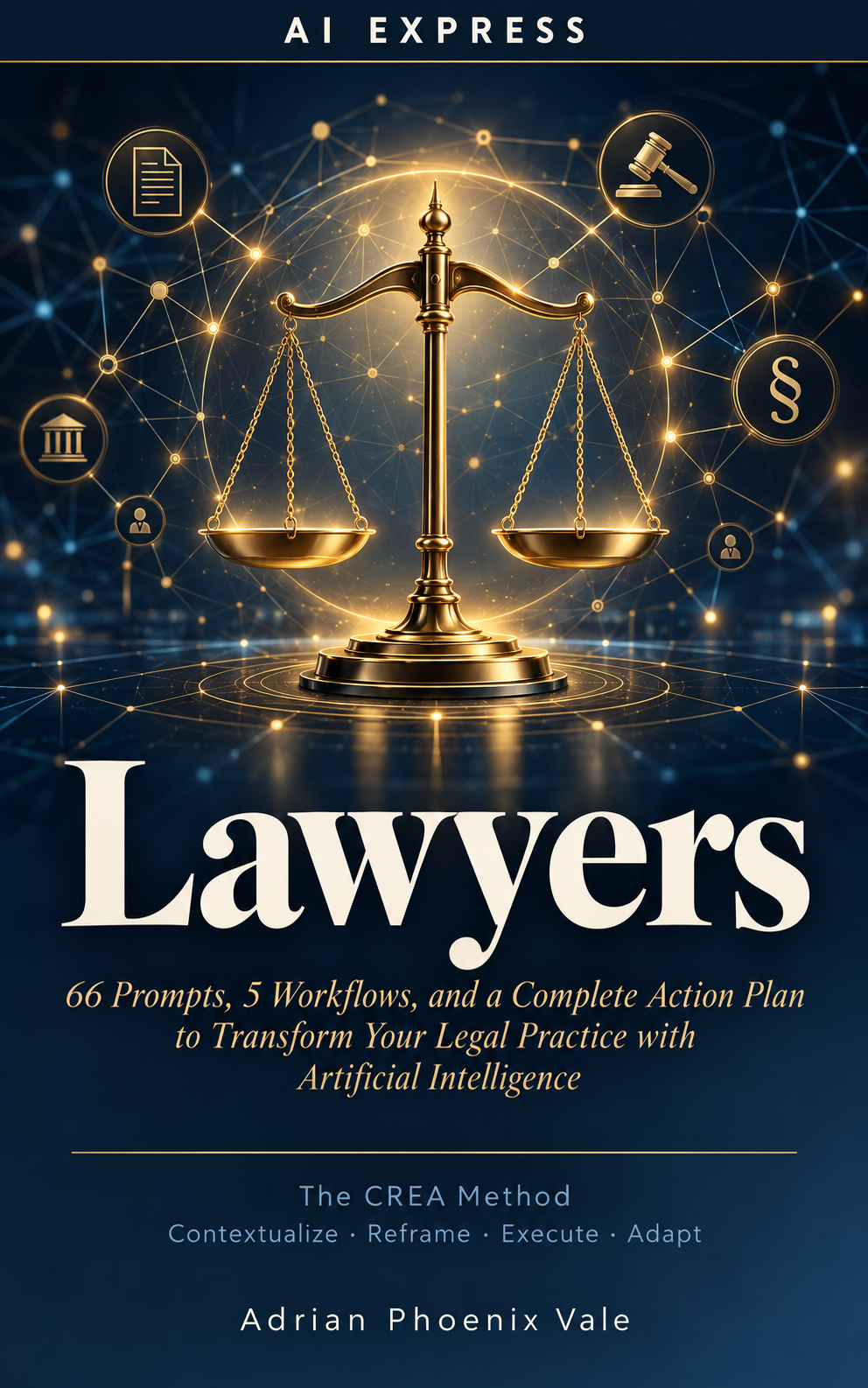
AI Express — Lawyers is the most comprehensive, practical AI guide written specifically for the legal profession. 66 prompts. 5 workflows. 5 case studies. 40 chapters. 628 pages. Full ethics framework. Zero fluff.
Also read:
- AI-powered legal research: how to cut case analysis time by 70%
- ABA Model Rules and AI: ethics compliance for attorneys in 2026
- AI contract review and drafting: the practical guide for law firms
- How solo practitioners compete with big firms using AI
Get the Complete Legal AI System
You've read the overview. Now get the full system — 66 prompts covering every practice domain, 5 workflows with 40-80% time savings, and an ethics framework that keeps you protected.