AI for Nurses: The Complete Guide to Transforming Your Nursing Practice in 2026
Nurses spend 35% of their shift on documentation.
Not at the bedside. Not educating patients. Not catching the medication interaction that the system missed. Documentation. Charting. SOAP notes. Shift handoffs. Care plan updates. Incident reports. Discharge summaries.
That's roughly four hours of a twelve-hour shift spent typing instead of caring. And the documentation burden is growing — not shrinking — as regulatory requirements expand, electronic health records become more complex, and patient acuity increases.
Artificial intelligence won't replace nurses. The complexity, compassion, and clinical judgment that define nursing are irreplaceable. But AI can reclaim those four hours — by handling the repetitive, time-consuming cognitive tasks that consume a nurse's day without requiring a nurse's expertise.
This isn't about becoming a tech expert. It's about using tools that already exist to work smarter, document faster, educate patients better, and protect yourself from the burnout that's driving nurses out of the profession.
Why 2026 Is the Year AI Becomes Essential for Nurses
The nursing workforce crisis
The numbers are stark. The United States faces a projected shortage of hundreds of thousands of registered nurses. The average age of working nurses is climbing. And post-pandemic burnout has accelerated retirements and career changes at unprecedented rates.
Hospitals can't hire their way out of this crisis. There aren't enough nurses to hire. The only sustainable solution is to make existing nurses more efficient, more effective, and more supported — so they can deliver better care to more patients without sacrificing their own wellbeing.
AI is the most powerful efficiency tool nursing has ever had.
The documentation crisis
Electronic Health Records were supposed to make documentation easier. For most nurses, they made it worse. The average nurse navigates multiple systems, clicks through dozens of screens, and types thousands of words per shift — often after their patients are asleep, during time that should be rest or recovery.
AI-powered documentation tools don't replace EHR systems. They work alongside them — generating structured notes, drafting care plans, summarizing shift events, and formatting handoff reports in a fraction of the time manual documentation requires.
The AI tools are finally ready
Early healthcare AI was unreliable, non-compliant, and designed for physicians, not nurses. The current generation of AI tools is different. They understand nursing workflows. They can be configured for HIPAA compliance. They produce output that nurses can verify, edit, and trust. And they require zero technical background to use.
The Six Domains Where AI Transforms Nursing
1. Clinical documentation
This is where AI saves the most time and delivers the most immediate impact.
SOAP notes. Instead of typing a complete Subjective-Objective-Assessment-Plan note from scratch, provide AI with the key data points — patient complaint, vitals, assessment findings, interventions — and it generates a structured, professional note in seconds. You review, edit, and approve. The heavy lifting is done.
Shift handoff reports. The SBAR format (Situation-Background-Assessment-Recommendation) is standard, but creating a comprehensive handoff for every patient at the end of a 12-hour shift is exhausting. AI can synthesize the shift's events into a structured SBAR report — capturing medication changes, lab results, assessments, and pending orders — so nothing falls through the cracks.
Care plan updates. AI can generate individualized care plans based on diagnosis, assessment data, and evidence-based nursing interventions. The nurse reviews and customizes — but the starting point is comprehensive, current, and properly formatted.
Incident reports. When something goes wrong, documentation must be thorough, objective, and timely. AI helps structure incident reports to capture all required elements — without the emotional charge that often affects documentation written immediately after a critical event.
2. Patient education
Patient education is one of nursing's most important — and most under-resourced — functions. Nurses are expected to explain complex medical conditions, medication regimens, and discharge instructions to patients with varying levels of health literacy, in increasingly shorter timeframes.
Health literacy-adjusted materials. AI generates patient education materials at any reading level — from sixth-grade to professional. The same explanation of heart failure management can be produced in simple, concrete language for one patient and detailed, clinical language for another.
Culturally sensitive content. AI can adapt patient education materials to reflect cultural considerations — dietary guidelines that account for traditional foods, medication instructions that acknowledge family decision-making structures, and self-care recommendations that respect cultural practices.
Multilingual materials. For nurses serving diverse populations, AI can translate education materials into dozens of languages — not machine-translated gibberish, but clear, medically accurate content that patients can actually understand.
Visual aids. AI can generate descriptions for visual aids, simplified medication schedules, and step-by-step procedure guides that complement verbal education.
3. Medication safety
Medication errors remain one of the leading causes of preventable patient harm. AI adds an additional layer of verification that complements existing safety systems.
Interaction checking. While pharmacy systems flag major interactions, AI can help nurses identify subtle interactions, contraindications, and dosing considerations that automated systems sometimes miss — particularly with complex polypharmacy patients.
Patient counseling guides. For each medication, AI generates a counseling guide covering mechanism of action, expected effects, side effects to watch for, food interactions, and when to call the provider — written in language the patient can understand.
Verification checklists. AI can create customized medication verification checklists for high-risk medications, complex regimens, and patient populations with specific safety considerations.
4. Career development
Nursing careers require continuous learning, certification maintenance, and strategic positioning. AI can accelerate every aspect of professional development.
Certification preparation. Whether it's CCRN, NCLEX, CNL, or a specialty certification, AI can generate practice questions, explain complex concepts, and create personalized study plans based on identified knowledge gaps.
Resume and cover letter optimization. AI can craft nursing-specific resumes that highlight clinical competencies, certifications, patient outcomes, and leadership experience — optimized for ATS systems and hiring managers.
Negotiation preparation. AI helps nurses research market rates, prepare talking points for salary negotiations, and craft professional communications for advancement discussions.
Continuing education. AI can summarize new research, translate clinical guidelines into practical implications, and generate study materials for CEU requirements.
5. Administration and leadership
Nurse leaders face unique challenges — managing staffing, budgets, quality metrics, and team dynamics while maintaining clinical credibility. AI is a force multiplier for nursing administration.
Staffing optimization. AI can analyze patient acuity data, historical census patterns, and staff availability to generate staffing recommendations that balance patient safety with budget constraints.
Quality improvement. AI can identify trends in incident reports, patient satisfaction data, and clinical outcomes — surfacing patterns that manual review would miss and suggesting evidence-based interventions.
Budget proposals. AI can structure budget proposals with data-driven justifications — translating patient outcomes data into financial impact language that administrators understand.
Policy development. AI can draft clinical policies and procedures based on current evidence, regulatory requirements, and institutional standards — providing a comprehensive starting point that clinical leaders can refine.
6. Telehealth and remote care
The expansion of telehealth created new workflows that most nurses were never trained for. AI bridges the gap.
Triage protocols. AI can help design and implement telehealth triage protocols that systematically assess patient acuity through virtual encounters — ensuring no critical symptoms are missed.
Virtual assessment frameworks. AI generates structured assessment guides for virtual encounters — what to observe, what questions to ask, and what documentation to capture when you can't physically examine the patient.
Remote monitoring workflows. For patients with chronic conditions using remote monitoring devices, AI can help design alert thresholds, escalation protocols, and documentation templates.
HIPAA and Compliance: The Non-Negotiable Foundation
What every nurse must know about AI and HIPAA
Protected Health Information (PHI) is sacred. Never enter identifiable patient information into a general-purpose AI tool. No names. No dates of birth. No medical record numbers. No combinations of demographics that could identify a patient.
Use de-identified data. When using AI for documentation, education, or analysis, strip all 18 HIPAA identifiers before inputting any patient-related information. AI can work with clinical scenarios, symptom sets, and care parameters without knowing who the patient is.
Institutional policies matter. Many healthcare organizations have specific policies governing AI use. Know your institution's policy before using any AI tool — and if no policy exists, advocate for one.
State Nurse Practice Acts. AI doesn't change your scope of practice. Any AI-generated recommendation must be reviewed against your professional judgment and your state's Nurse Practice Act. AI suggests. Nurses decide.
ANA Position Statements. The American Nurses Association has addressed AI in nursing practice. Familiarize yourself with their guidance — it provides a professional framework for responsible AI adoption.
Building compliance into your workflow
- Never input PHI into any AI tool that isn't specifically HIPAA-compliant and covered by a Business Associate Agreement
- De-identify before you prompt — remove all 18 HIPAA identifiers before entering any clinical scenario
- Review every output — AI-generated clinical content must be verified by a qualified nurse before use
- Document your process — maintain records of how AI tools are used in your practice
- Know your policies — follow your institution's AI governance framework
The CREA Method for Nursing
The CREA Method — Contextualize, Reframe, Execute, Adapt — transforms any AI tool into an expert nursing assistant.
Contextualize. Before writing any prompt, define the clinical context. What type of unit? What patient population? What acuity level? What are the institutional standards? A SOAP note for a med-surg patient is different from one for an ICU patient — and your prompts should reflect that.
Reframe. Challenge your first instinct. If you're using AI to write a care plan, reframe: could it also identify nursing diagnoses you haven't considered? If you're using it for patient education, reframe: could it also generate teach-back questions to verify comprehension?
Execute. Run the prompt. Review the output with clinical judgment. Check for accuracy. Check for completeness. Check for compliance. AI is your first draft, not your clinical decision.
Adapt. Refine based on outcomes. The best nursing AI users build prompt libraries customized to their unit, patient population, and institutional standards — refined over time through clinical experience.
Getting Started: The 7-Day Plan
Day 1-2: Identify your three biggest time drains. For most nurses, it's documentation, patient education, and care planning.
Day 3: Learn the CREA Method. Practice with one simple task — a discharge instruction template or a shift handoff format.
Day 4-5: Build your first three prompts. Start with documentation — the highest-impact, lowest-risk application.
Day 6: Compliance check. Review your AI workflow against HIPAA requirements, your Nurse Practice Act, and institutional policy.
Day 7: Deploy. Use your first AI-assisted workflow during a shift. Time the difference. Evaluate the quality. Refine and expand.
The Bottom Line
The nursing profession is under more pressure than at any point in modern history. The workforce is shrinking. The documentation burden is growing. Patient acuity is increasing. And burnout is driving experienced nurses out of the profession.
AI won't solve the systemic issues that created this crisis. But it will give you back hours of your shift. It will make your documentation more thorough and more consistent. It will help you educate patients more effectively. And it will support your career development in ways that simply weren't possible before.
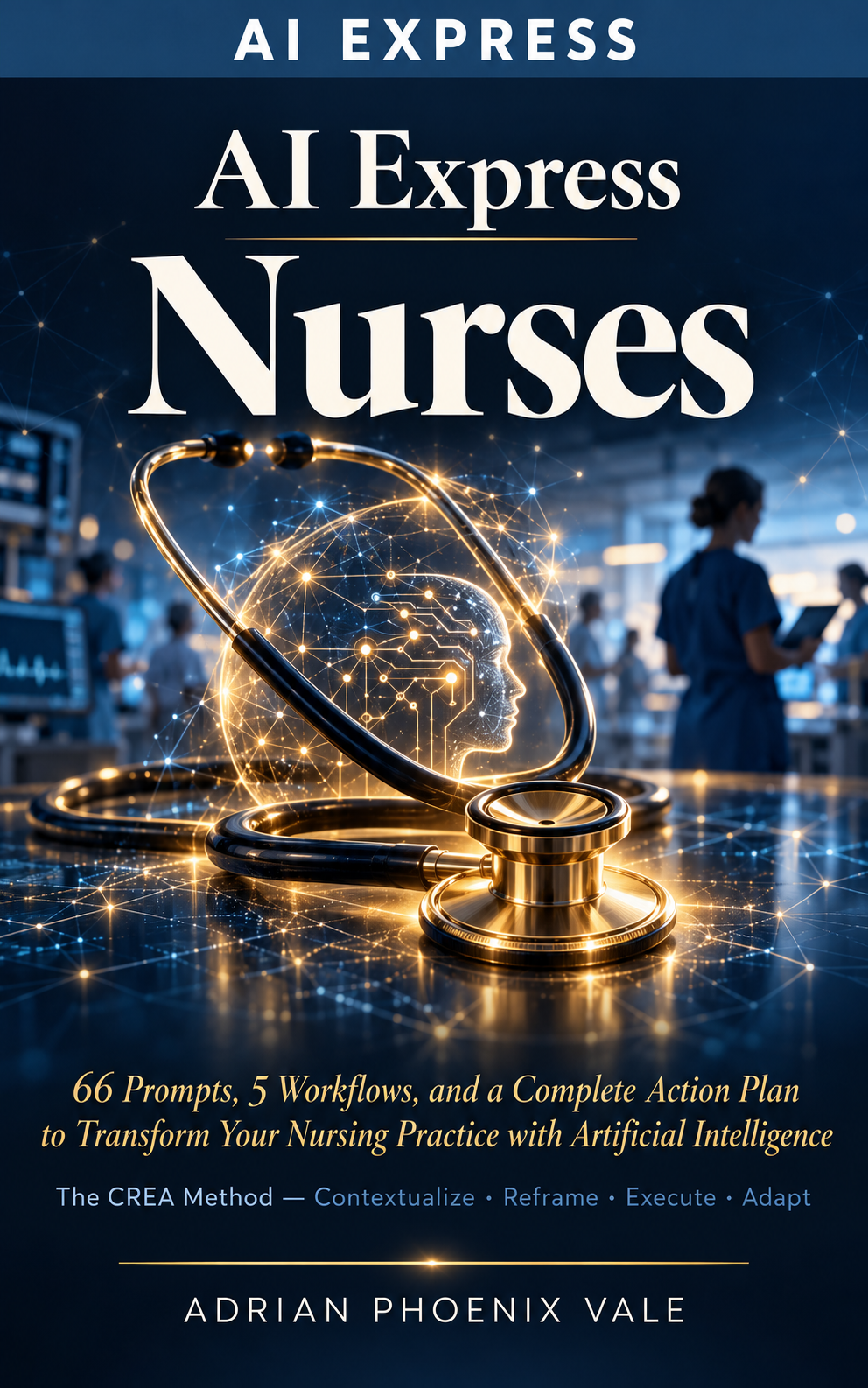
AI Express — Nurses is the most comprehensive, practical AI guide written specifically for the nursing profession. 66 prompts. 5 workflows. 5 case studies. 40 chapters. 604 pages. Full HIPAA compliance framework. Zero fluff.
The nurses who master AI now will lead the profession forward. Will you be one of them?
Also read:
- AI-powered clinical documentation: how nurses save 15 hours per week
- HIPAA and AI: what every nurse must know about compliance in 2026
- Nurse burnout solutions: evidence-based strategies that actually work
- Telehealth nursing: how to deliver excellent remote patient care
Get the Complete Nursing AI System
You've read the overview. Now get the full system — 66 HIPAA-conscious prompts you can use today, 5 workflows designed for real nursing shifts, and a compliance framework that keeps you protected.