Nurse Burnout Solutions: Evidence-Based Strategies That Actually Work in 2026
Burnout isn't a personal weakness. It's a systems failure.
When a nurse who loved her profession for fifteen years starts dreading every shift, that's not a character flaw. When an ICU nurse with impeccable clinical skills calls in sick for the third time this month, that's not a motivation problem. When a new graduate leaves the profession within eighteen months of starting, that's not an onboarding gap.
It's burnout. And it's the single greatest threat to the nursing workforce in 2026.
The World Health Organization defines burnout as a syndrome resulting from chronic workplace stress that has not been successfully managed. It manifests in three dimensions: emotional exhaustion, depersonalization (treating patients as tasks rather than people), and reduced personal accomplishment. All three are epidemic in nursing.
The solutions aren't motivational posters in the break room. They're structural changes that address the root causes of burnout — and new tools, including AI, that can fundamentally reduce the daily burden that drives nurses to the breaking point.
The Root Causes (Not What You Think)
Documentation overload
The number-one contributor to nursing burnout isn't patient acuity, difficult families, or even short staffing — it's documentation. Studies consistently rank the documentation burden as the primary driver of nursing dissatisfaction and burnout.
The average nurse spends 25-40% of their shift on documentation — time that could be spent at the bedside, with patients and families, doing the work that drew them to nursing in the first place. And when documentation can't be completed during the shift, nurses stay late — unpaid overtime that erodes both time and morale.
The AI solution: AI-powered documentation tools can reduce charting time by 50-70%. SOAP notes that took 15 minutes can be generated in 3 minutes and reviewed in 5. Shift handoff preparation drops from 30 minutes to 10. Care plan updates become a 5-minute review instead of a 20-minute rebuild. The cumulative time savings — two to three hours per shift — represent the single most impactful burnout intervention available today.
Staffing inadequacy
Short staffing isn't just inconvenient. It's dangerous and demoralizing. When a nurse responsible for four patients is suddenly caring for seven, every aspect of care suffers — assessments are rushed, education is skipped, documentation is deferred, and the nurse carries the moral weight of knowing they can't provide the care their patients deserve.
What works: Predictive staffing models that use AI to analyze patient acuity, census patterns, and historical data to forecast staffing needs before they become crises. Flexible staffing pools that respond to real-time acuity changes. And transparent staffing ratios that give nurses confidence that their workload is manageable.
Moral injury
Moral injury occurs when nurses are forced to act — or fail to act — in ways that violate their professional values. A nurse who knows a patient needs education but doesn't have time. A nurse who recognizes a safety concern but can't get a provider's attention. A nurse who delivers care below their own standards because the system won't support excellence.
Moral injury is deeper than stress. It attacks professional identity itself.
What works: Giving nurses the time and tools to practice at the level their training and values demand. When AI handles documentation and administrative tasks, nurses spend more time doing meaningful clinical work — which directly addresses the moral injury at burnout's core.
Lack of autonomy and voice
Nurses consistently report feeling excluded from decisions that affect their practice. Policies are created without nursing input. Technology is implemented without workflow consideration. Schedules are designed for administrative convenience rather than clinical effectiveness.
What works: Shared governance structures that give nurses real decision-making authority. Technology advisory committees that include frontline nurses. Schedule flexibility that respects personal needs. And leadership that listens — genuinely — to the people delivering care.
Career stagnation
Nursing offers fewer visible career advancement pathways than most professions. The traditional trajectory — bedside nurse to charge nurse to manager to director — doesn't appeal to everyone. And for clinical nurses who want to advance without leaving the bedside, options are limited.
What works: Expanded clinical ladders. Specialty certification support and recognition. Advanced practice pathways. Education benefits. Research and quality improvement opportunities. And AI tools that help nurses document their contributions, prepare for certifications, and position themselves for advancement.
Seven Evidence-Based Solutions
1. Reduce the documentation burden with AI
This is the highest-impact, most immediately actionable burnout intervention. AI documentation tools are available now, require no institutional infrastructure changes, and deliver measurable results within days.
Start here: Identify the three most time-consuming documentation tasks on your unit. Build AI prompt templates for each one. Test them during one shift. Measure the time savings. Scale to the full documentation workflow.
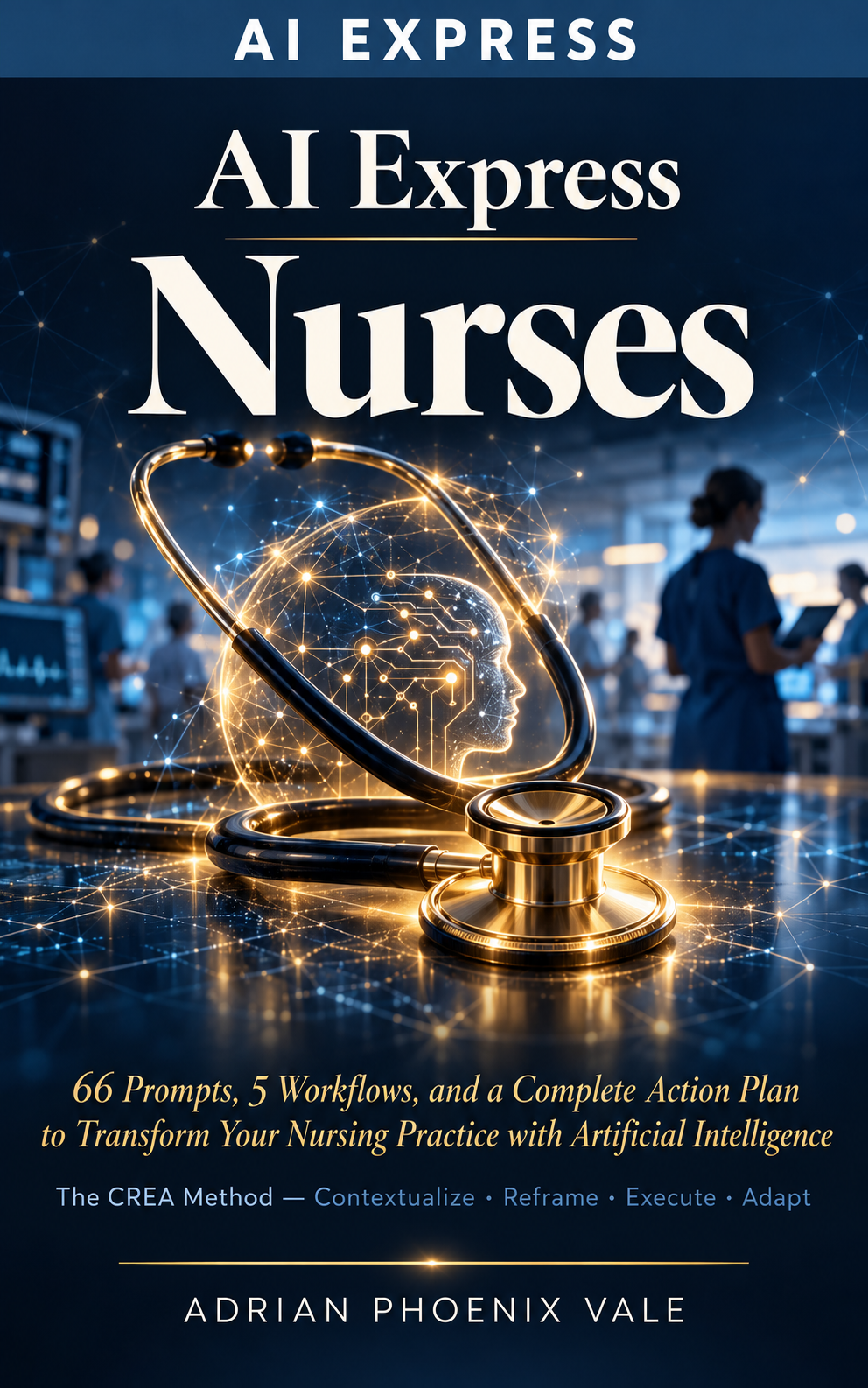
The book AI Express — Nurses provides 66 ready-to-use prompts covering every major documentation type — SOAP notes, SBAR handoffs, care plans, discharge instructions, incident reports, and more. All HIPAA-conscious. All field-tested.
2. Implement evidence-based resilience programs
Not all resilience programs work. The ones that do share common characteristics: they're brief, they're practical, they're integrated into the work day (not added to it), and they address systemic issues alongside individual coping.
What the evidence supports:
- Mindfulness-based stress reduction programs adapted for healthcare settings
- Peer support programs with trained nurse facilitators
- Schwartz Center Rounds — structured forums for discussing the emotional impact of patient care
- Code Lavender programs for acute emotional distress
- Debrief protocols after critical events
What doesn't work: Telling burned-out nurses to do yoga. Pizza parties. Generic wellness apps that add one more thing to an already overwhelming day.
3. Fix staffing with data, not guesswork
AI-powered staffing models can predict census fluctuations, acuity changes, and staffing needs with remarkable accuracy — allowing proactive staffing adjustments instead of reactive scrambling.
What to build:
- Acuity-based staffing ratios that adjust in real time
- Predictive models that forecast high-census periods and trigger early float pool activation
- Transparent staffing dashboards that show nurses the rationale behind assignments
- Closed-loop feedback systems where nurses can report unsafe staffing in real time
4. Create meaningful career pathways
Nurses need to see a future in nursing — not just a future in management.
Build pathways for:
- Clinical advancement (clinical nurse specialist, nurse educator, clinical research)
- Leadership development (charge nurse training, management residency, executive fellowship)
- Specialty expertise (certification support, conference attendance, publication mentoring)
- Education (tuition benefits, flexible scheduling for degree programs, clinical instructor opportunities)
- Innovation (quality improvement project leadership, technology advisory roles, evidence-based practice committees)
5. Restore autonomy and voice
Nurses who feel heard are more engaged, more satisfied, and less likely to burn out — even when workload is high.
Structural changes:
- Unit-based shared governance councils with real decision-making authority
- Nurse representation on institutional committees (technology, safety, quality, policy)
- Regular forums where frontline nurses can raise concerns directly with leadership
- Transparent follow-up on nurse-reported issues — closed-loop communication that shows action
6. Address the physical environment
The physical demands of nursing compound psychological burnout. Twelve-hour shifts on hard floors. Inadequate break spaces. Noisy, chaotic environments. Equipment that doesn't work reliably.
What makes a difference:
- Dedicated, quiet break rooms (not repurposed storage closets)
- Ergonomic workstations for documentation
- Reliable equipment and timely maintenance
- Noise reduction strategies in patient care areas
- Safe, well-lit parking for night-shift nurses
7. Build a culture of recognition
Not recognition programs — recognition culture. The difference is authenticity. Programs are systematic. Culture is genuine.
What authentic recognition looks like:
- Specific, timely acknowledgment of exceptional clinical work
- Peer-to-peer recognition that's visible and valued
- Leadership that notices effort, not just outcomes
- Celebration of clinical excellence alongside operational metrics
- Annual awards that are nominated by peers, not selected by administration
Measuring Burnout and Intervention Effectiveness
You can't fix what you don't measure. Track these metrics regularly:
Maslach Burnout Inventory (MBI) — the gold-standard burnout assessment tool, measuring emotional exhaustion, depersonalization, and personal accomplishment. Administer quarterly.
Turnover rate — overall and by unit. High turnover is burnout's most visible symptom.
Vacancy rate — open positions as a percentage of budgeted positions. Rising vacancies signal a retention problem.
Overtime hours — particularly mandatory and documentation-related overtime. This is a leading indicator.
Sick call frequency — increasing absences often precede resignations.
Engagement survey scores — but only if the survey asks specific, actionable questions and results drive visible changes.
Patient outcomes — burnout correlates with medication errors, falls, infections, and patient satisfaction scores. When burnout decreases, outcomes improve.
The Bottom Line
Nurse burnout is a solvable problem. Not with platitudes, not with pizza, and not by telling nurses to be more resilient. It's solved with structural changes that address the root causes — documentation burden, staffing, autonomy, career development, and institutional culture.
AI is the most powerful new tool in that solution set. By reclaiming the hours that documentation consumes, AI gives nurses back the time to practice at the level their training and values demand — which is the most effective burnout intervention ever developed.
Also read:
- AI for nurses: the complete guide to transforming your practice in 2026
- AI-powered clinical documentation: how nurses save 15 hours per week
- How to advance your nursing career with AI-powered tools
- Telehealth nursing: how to deliver excellent remote patient care
Reclaim Your Time, Reclaim Your Practice
The documentation burden is the most actionable driver of burnout — and AI is the most effective solution. AI Express — Nurses gives you 66 prompts to cut charting time in half, starting today.