How to Stay Calm When Someone Disrespects You: The Stoic Method
Someone just said something that hit you like a punch. Maybe it was a colleague undermining you in a meeting. A family member questioning your decisions. A stranger being needlessly rude.
Your jaw clenches. Your heart rate spikes. The words are already forming in your mouth — sharp, defensive, ready to fire.
Here's what the Stoics knew 2,000 years ago that neuroscience has since confirmed: the first 90 seconds after a provocation are a trap. Your amygdala has hijacked your rational brain. Whatever you say or do in those 90 seconds is not you at your best — it's your survival instinct performing an emergency response to something that isn't actually an emergency.
The Stoic Method isn't about becoming a doormat. It's about becoming dangerous in the right way — calm, deliberate, and impossible to manipulate.
Why Disrespect Triggers Us So Powerfully
Disrespect activates the same brain circuits as physical threat. Neuroscientist Matthew Lieberman's research at UCLA showed that social rejection and physical pain share the same neural pathways. When someone disrespects you, your brain literally processes it as an attack.
This made sense when we lived in tribes. Social rejection could mean exile, and exile meant death. Your brain learned to treat disrespect as a survival threat — reacting immediately and intensely.
The problem: in modern life, this response creates more damage than it prevents. The sarcastic comeback that feels satisfying for 5 seconds creates workplace tension for months. The angry text you fire off at midnight looks very different at 7 AM.
The 4-Step Stoic Method for Disrespect
Step 1: The Pause (0-10 seconds)
Marcus Aurelius wrote: "The best revenge is to not be like your enemy."
When disrespect lands, do nothing for 10 seconds. Not because you're weak — because you're taking back control from your amygdala. Those 10 seconds allow your prefrontal cortex to come back online.
What to do physically during the pause:
- Exhale slowly (longer exhale than inhale — 4 seconds in, 6 seconds out)
- Drop your shoulders — they've tensed without you noticing
- Unclench your jaw — this sends a "stand down" signal to your nervous system
- Plant your feet flat on the ground — physical grounding stabilizes mental state
Step 2: The Assessment (10-30 seconds)
Epictetus taught: "It is not things that disturb us, but our judgments about things."
During these 20 seconds, run three rapid mental checks:
Check 1 — Intent: Did they mean to disrespect you, or are you interpreting neutral words through an emotional filter? Research shows we overestimate hostile intent by roughly 40% when we're already stressed.
Check 2 — Source: Does this person's opinion actually matter to you? Seneca asked: "Would you be upset if a stranger's dog barked at you?" Much disrespect comes from people whose judgment you wouldn't trust on any other topic.
Check 3 — Content: Is there a 10% chance they're pointing at something real, however clumsily? If yes, you've received free feedback. If no, their words tell you about them, not about you.
Step 3: The Strategic Response (after 30 seconds)
This is where the Stoic method diverges from both passivity and aggression. You don't ignore the disrespect — and you don't match it. You choose the response that serves your long-term interest.
Option A — The Question (most powerful): Calmly ask: "What specifically do you mean by that?" or "Can you elaborate on what you're saying?"
This does three things simultaneously: it forces the other person to explain (and usually moderate) their position, it signals that you're not rattled, and it gives you more information while giving them less.
Option B — The Acknowledgment Without Concession: "I hear what you're saying. I see it differently." Then stop talking. No justification. No defense. The brevity is the power.
Option C — Strategic Silence: Sometimes the most devastating response is no response at all. Silence after a provocation is deeply uncomfortable for the person who expected a reaction. It forces them to fill the void — and people filling uncomfortable silence almost always overexplain, backtrack, or reveal their actual motivation.
Option D — The Exit: "I'd be happy to discuss this when we can both approach it constructively." Then leave — physically or conversationally. This isn't retreat. It's controlling the terrain.
Step 4: The Post-Processing (later that day)
This step is what most people skip — and it's what turns a single incident into lasting growth.
That evening, spend five minutes journaling:
- What was the trigger?
- What was my initial impulse?
- What did I actually do?
- What would my wisest self have done?
- What pattern does this reveal?
Over time, this journal becomes a map of your triggers — and a manual for disarming them.
The Workplace Application
Workplace disrespect is especially charged because it involves your livelihood and reputation. The stakes feel higher, which makes the amygdala response stronger.
The meeting interruption: Someone talks over you or takes credit for your idea. The Stoic response: finish your thought calmly, then address it directly — "I'd like to complete the point I was making" or, later, "I'm glad that idea resonated — it was the approach I outlined in my email on Tuesday." Calm, factual, devastating.
The passive-aggressive email: Someone CCs your boss on a criticism that could have been a private conversation. The Stoic response: reply privately, addressing only the substance. Never escalate the audience. The person who stays professional while the other person plays politics always wins the longer game.
The condescending tone: Someone explains something to you that you clearly already know. The Stoic response: "Thanks — I'm familiar with that. Here's what I've been thinking about the next step." Redirect without confrontation.
The Relationship Application
Disrespect from people you love cuts deeper because trust makes you more vulnerable. The Stoic method still applies — but with an additional principle: address the pattern, not just the incident.
After the immediate moment passes (using Steps 1-3), have a separate conversation: "When you said X, I felt Y. I need Z going forward."
This format — specific behavior, your experience, clear request — is both Stoic and effective. It addresses the problem without escalating into character attacks.
What Happens When You Practice This for 30 Days
People who practice the Stoic Method report three consistent changes:
Week 1-2: The pause gets easier. You'll still feel the surge of anger or hurt, but the gap between feeling it and acting on it grows from zero to measurable seconds.
Week 2-3: You start noticing triggers before they fire. The pattern recognition from Step 4 journaling pays dividends — you see the provocation coming and prepare your response in advance.
Week 3-4: Other people's disrespect starts feeling less personal. Not because you've become numb — because you've trained your brain to process it through assessment (Step 2) instead of pure emotion.
The long-term result: you become the person in the room who doesn't react. And that person — calm, composed, deliberate — commands more respect than the person who fires back every time.
Also read:
- How to Stop Reacting Emotionally: The Science-Backed Guide
- Machiavelli's 7 Laws of Power That Most People Learn Too Late
- How Stoic Philosophy Transforms Your Relationship with Anger
Build the Complete System
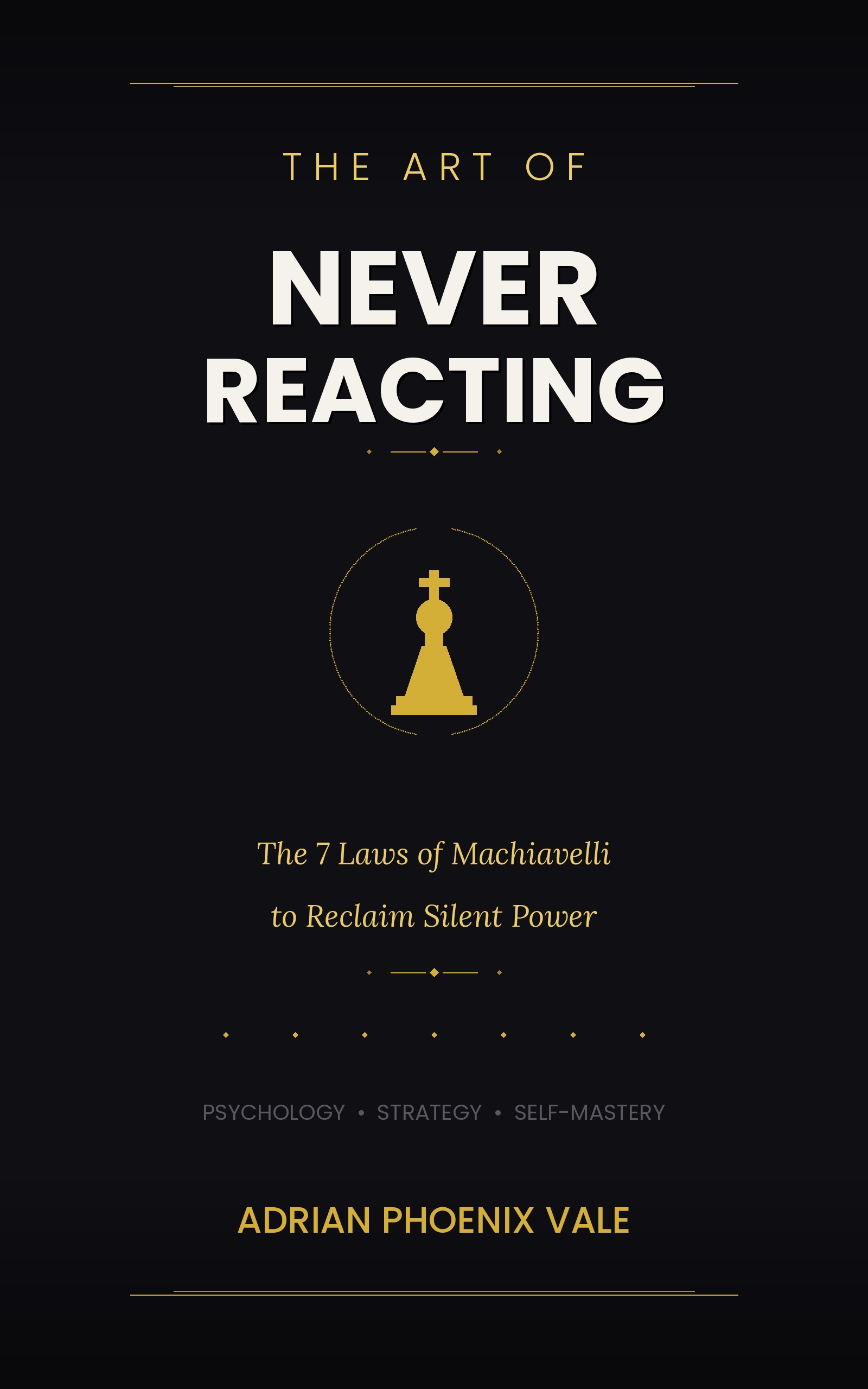
The 4-Step Method in this guide is the foundation. "The Art of Never Reacting: The 7 Laws of Machiavelli to Reclaim Silent Power" by Adrian Phoenix Vale builds on these principles with the full framework — 7 Laws, neuroscience-backed exercises, real-world scenarios from workplace to relationships, and a complete 30-Day Program that rewires your reactive patterns permanently.