Machiavelli's 7 Laws of Power That Most People Learn Too Late
Five centuries ago, a Florentine diplomat was thrown into prison, tortured, and exiled from political life. With nothing left to lose, Niccolò Machiavelli sat down and wrote the most dangerous book ever published — a book that stripped away every comfortable illusion about how power actually works.
Most people know Machiavelli as the author of The Prince. Few understand what he actually taught. His philosophy wasn't about cruelty or tyranny. It was about seeing the world as it is — not as you wish it were — and acting accordingly.
The 7 Laws distilled from his work aren't relics from Renaissance Italy. They're operating right now in every boardroom, every negotiation, every relationship where one person holds more influence than another. The question isn't whether these laws exist. The question is whether you recognize them before someone uses them on you.
Law 1: Master Your Reactions Before You Master Anything Else
Machiavelli observed that the leaders who fell fastest were those who wore their emotions openly. Not because emotion is weakness — but because visible emotion is information. And information, in any power dynamic, is currency.
When you react emotionally to a provocation, you've told the other person exactly what triggers you. You've revealed which buttons to press. You've handed them a map of your vulnerabilities — for free.
The first law isn't about suppressing emotion. It's about choosing when and how to display it. A calculated show of anger can be devastating. An uncontrolled outburst is always a loss.
Modern application: The next time someone says something designed to get a rise out of you — in a meeting, in a text, on social media — treat the moment as a data collection opportunity. What are they trying to achieve by provoking you? What would they gain from your reaction? Answer those questions silently, and you've already won the exchange.
Law 2: Never Reveal Your Full Intentions
Machiavelli wrote that a leader should be like a fox — appearing to go in one direction while moving in another. This wasn't advice to be dishonest. It was a recognition that transparency about your end goal gives others the ability to block it.
In modern terms: the person who announces "I'm going for the promotion" before they've built the coalition to get it has just given every competitor time to prepare. The person who quietly builds alliances, delivers results, and positions themselves as the obvious choice doesn't need to announce anything.
Modern application: Share your progress, not your plans. Talk about what you've done, not what you intend to do. Let results speak first; explanations follow.
Law 3: Study People More Than You Study Problems
Machiavelli's genius wasn't political theory — it was observation. He watched how people actually behaved under pressure, in private, when they thought no one was paying attention. He understood that solving a problem means nothing if you don't understand the people involved.
Most people approach workplace conflicts, negotiations, and difficult conversations by analyzing the problem. Machiavellian thinking starts with the people: What do they want? What do they fear? What would they never admit publicly but act on privately?
Modern application: Before your next difficult conversation, spend five minutes mapping the other person's incentives. What are they afraid of losing? What would make them look good to the people they care about? Build your approach around their motivations, not your arguments.
Law 4: Make Others Come to You
Machiavelli observed that the person who pursues always has less power than the person who is pursued. When you chase — a client, a promotion, a relationship — you implicitly communicate that the other party has something you need. This shifts the power balance before the conversation even begins.
The strategic alternative: create conditions where others seek you out. Become the person with expertise, with connections, with solutions that others need.
Modern application: Instead of cold-calling prospects, create content that demonstrates your expertise and attracts them to you. Instead of lobbying for a role, build a track record that makes you the obvious choice. Instead of begging for attention, become genuinely interesting.
Law 5: Use Selective Honesty to Disarm
One of Machiavelli's most counterintuitive insights: a single act of genuine honesty can cover a dozen strategic moves. When you admit a weakness, acknowledge a mistake, or share a vulnerability, it creates such a powerful impression of trustworthiness that people stop scrutinizing your other actions.
This isn't about being dishonest. It's about understanding that honesty — particularly unexpected honesty — is one of the most disarming tools available. The person who admits "I don't have all the answers" is often trusted more than the person who claims to have every answer.
Modern application: When presenting a proposal, lead with the strongest objection someone could raise — and address it honestly before they can. This demonstrates confidence, thoroughness, and trustworthiness simultaneously.
Law 6: Protect Your Reputation as If It Were Currency
Machiavelli understood that reputation is a multiplier. With a strong reputation, your words carry weight before you speak them. With a damaged reputation, even your best work is viewed with suspicion.
The strategic principle: invest in your reputation continuously, defend it immediately when attacked, and never take it for granted. A reputation built over years can be destroyed in a single careless moment.
Modern application: Google yourself. Audit your digital presence. Consider how your actions, posts, and associations reflect on your professional identity. The people evaluating you — employers, clients, partners — are making judgments based on a composite picture you may not be curating deliberately.
Law 7: Think in Decades, Not Days
The final law separates strategic thinkers from reactive ones. Machiavelli consistently advised leaders to sacrifice short-term comfort for long-term positioning. The leader who avoids a difficult conversation today creates a bigger problem next year. The leader who accepts a temporary loss to position for a permanent advantage thinks the way Machiavelli intended.
Modern application: Before making any significant decision, ask: "How does this look in five years?" The job that pays more now but teaches less. The shortcut that saves time today but creates technical debt tomorrow. The relationship that feels exciting now but drains your energy consistently. Time reveals what impulse conceals.
Why These Laws Matter More in 2026
We live in an era of radical transparency — social media, public records, digital footprints. This makes Machiavelli's principles more relevant, not less. When everyone can see what you do, the ability to control how you do it — your timing, your framing, your emotional discipline — becomes the defining competitive advantage.
The people who dominate their industries, their negotiations, and their personal lives aren't the loudest or the most aggressive. They're the most deliberate. They've learned what Machiavelli taught five centuries ago: power belongs to those who understand the game well enough to play it on their own terms.
The Real Power Move: Self-Mastery
Every one of Machiavelli's laws ultimately points to the same foundation: self-mastery. You can't control your reactions if you don't understand your triggers. You can't think strategically if you're drowning in emotional noise. You can't play the long game if you're constantly putting out fires you started.
The ultimate competitive advantage isn't information, money, or connections. It's the ability to remain composed, strategic, and deliberate when everyone around you is losing control.
Also read:
- How to Stop Reacting Emotionally: The Science-Backed Guide
- Dark Side of Persuasion: How the 7 Laws Are Used Against You
- Best Stoicism Books for Emotional Control 2026
Go Deeper: The Complete 7-Law System
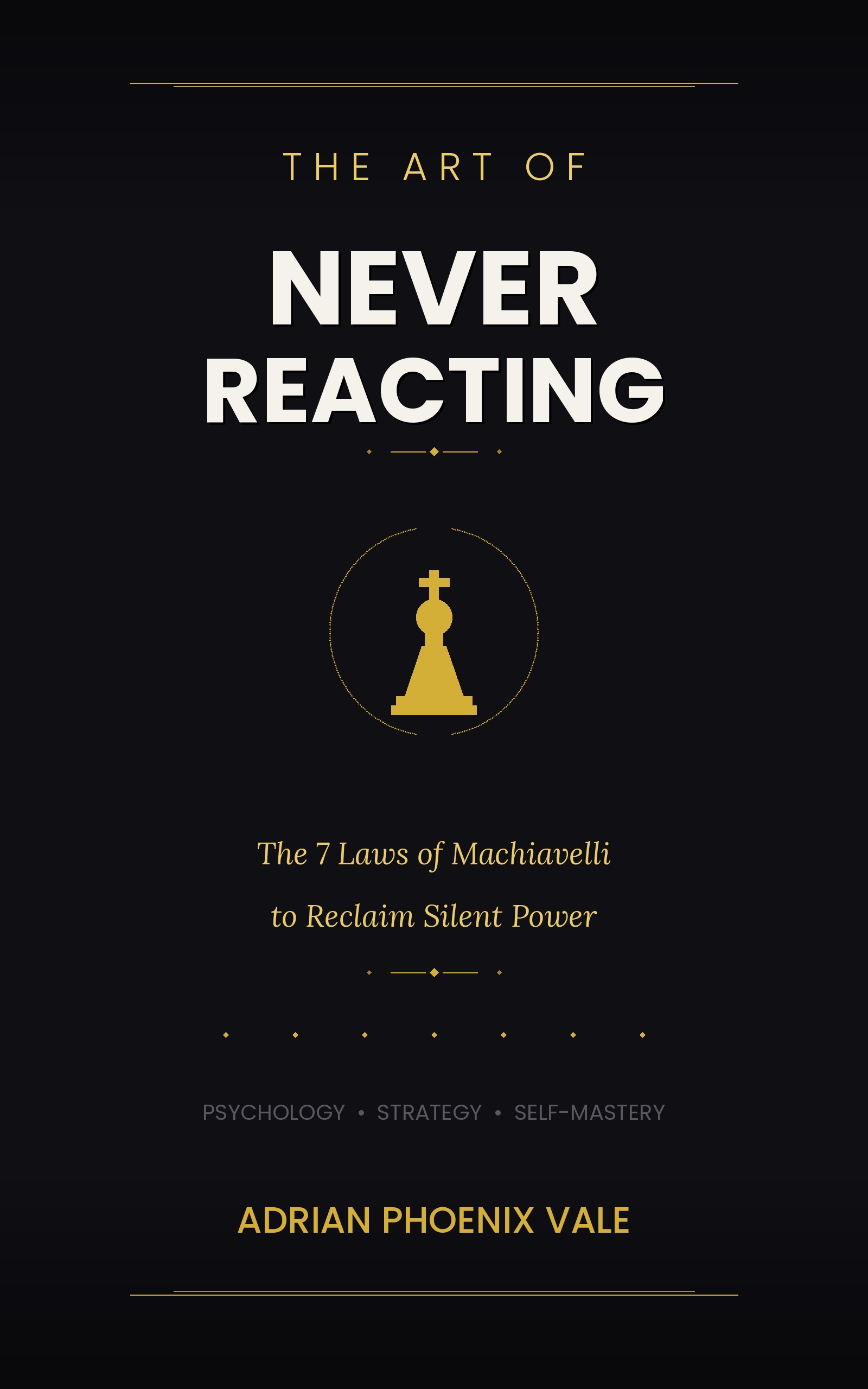
Machiavelli's principles are timeless — but applying them requires a structured system. "The Art of Never Reacting: The 7 Laws of Machiavelli to Reclaim Silent Power" by Adrian Phoenix Vale takes each law and builds it into an actionable framework with neuroscience-backed exercises, real-world scenarios, and a complete 30-Day Program to rewire your reactions permanently.