Best Dark Psychology Books 2026: 10 Books That Actually Teach You to Defend Yourself
Most dark psychology book lists recycle the same five titles without telling you which ones are worth your time and which are padded filler. This ranking is different — it prioritizes books that teach practical self-defense, backed by real psychology, and written by people who know what they're talking about.
Whether you want to spot manipulation in relationships, understand the psychology of influence at work, or simply stop being an easy target — these are the 10 best dark psychology books to read in 2026.
The 10 Best Dark Psychology Books — Full Ranking
#1. Influence: The Psychology of Persuasion — Robert B. Cialdini
Best for: Understanding the science behind why people say yes.
Cialdini spent decades studying compliance professionals — salespeople, con artists, fundraisers — and distilled their methods into six universal principles of persuasion: reciprocity, commitment, social proof, authority, liking, and scarcity. The 2021 revised edition adds a seventh: unity.
Why it ranks #1: Every dark psychology book published after 1984 builds on Cialdini's framework. If you read only one book on this list, this is the one. It is the foundation.
📄 336 pages · 🌐 English · ⭐ Psychology / Persuasion
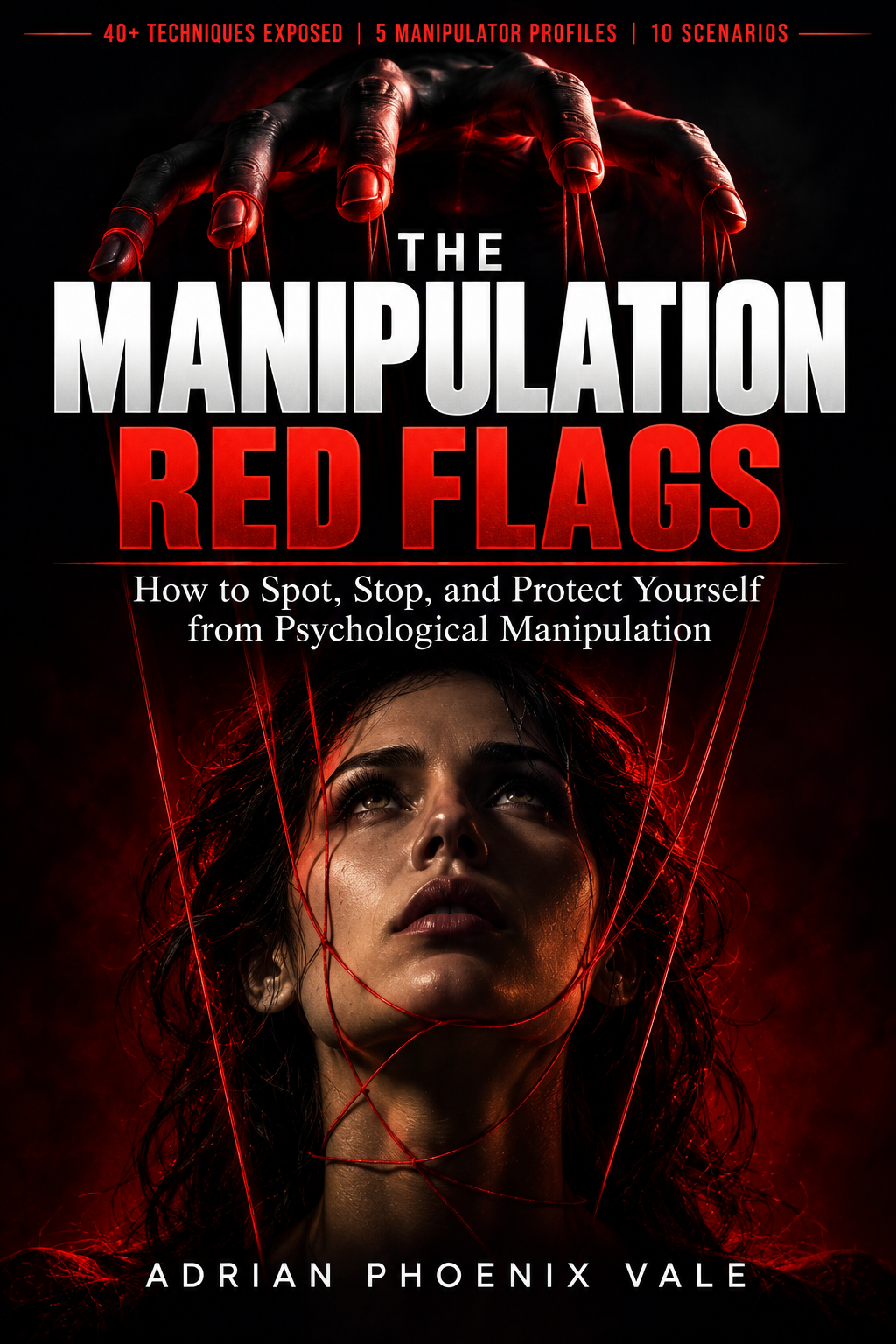
#2. The Manipulation Red Flags — Adrian Phoenix Vale
Best for: Learning to identify manipulation in real time — across all contexts.
Where most books describe manipulation in theory, this one gives you a 41-point detection system organized across six categories: emotional, verbal, social, psychological, power/control, and digital manipulation. Each flag includes the neuroscience behind why it works and a concrete defense strategy.
Includes five manipulator profiles (Narcissist, Passive-Aggressive, Covert Controller, Corporate Manipulator, Charming Predator), the Gray Rock Method, boundary-setting frameworks, BIFF communication, documentation strategies, and ten real-world scenario playbooks.
Why it ranks #2: No other book gives you this many concrete, categorized red flags with both the science and the defense for each one. It is a field manual, not a lecture.
📄 193 pages · 🌐 English · ⭐ Psychology / Self-Protection · $6.99 Kindle / $17.99 Paperback
>>> Get The Manipulation Red Flags on Amazon <<<
#3. The 48 Laws of Power — Robert Greene
Best for: Understanding how power dynamics have operated throughout history.
Greene maps out 48 laws drawn from historical figures — Machiavelli, Sun Tzu, Louis XIV, Bismarck — with narrative examples illustrating each law in action. The book reads like a strategy manual for navigating hierarchies, office politics, and competitive environments.
Why it ranks #3: Essential reading for understanding how power operates. The historical anecdotes are selectively chosen to prove each point, so treat it as a framework for recognition rather than a scientific text.
📄 452 pages · 🌐 English · ⭐ Psychology / Power Dynamics
#4. The Influence Blueprint — Adrian Phoenix Vale
Best for: Mastering ethical persuasion — and defending against those who don't play fair.
This book distills the 7 laws of ethical persuasion into a practical system: how to build genuine authority, create reciprocity that isn't manipulative, and use social proof without deception. The second half flips the script — teaching you to detect and neutralize each technique when used against you.
Why it ranks #4: Unique dual structure — offensive and defensive. Most persuasion books teach you to influence others but never address how to protect yourself from the same techniques.
📄 Pages · 🌐 English · ⭐ Psychology / Influence & Persuasion · $6.99 Kindle
>>> Get The Influence Blueprint on Amazon <<<
#5. In Sheep's Clothing — George K. Simon Jr.
Best for: Identifying covert aggression in personal relationships.
Simon focuses on the specific subset of manipulators who use passive-aggressive, covert tactics rather than overt intimidation. He calls them "covert-aggressive personalities" and explains why traditional psychology advice ("try to understand their childhood trauma") makes you more vulnerable, not less.
Why it ranks #5: Unusually practical for a clinical psychologist's book. The distinction between covert and overt aggression is one of the most useful frameworks in this field.
📄 176 pages · 🌐 English · ⭐ Psychology / Covert Aggression
#6. The Art of Never Reacting — Adrian Phoenix Vale
Best for: Building the internal discipline to stay strategically calm under pressure.
Based on Machiavelli's strategic framework, this book translates the 7 Laws of Silent Power into a modern system for personal sovereignty. Each law is rooted in historical precedent, validated by contemporary neuroscience, and designed for practical application: at work, in family dynamics, in conflict, and in negotiations.
Why it ranks #6: Fills a gap no other dark psychology book covers — the internal game. Detecting manipulation is half the battle; not reacting is the other half.
📄 Pages · 🌐 English · ⭐ Psychology / Strategic Self-Mastery · $4.99 Kindle
>>> Get The Art of Never Reacting on Amazon <<<
#7. Without Conscience — Robert D. Hare
Best for: Understanding psychopathy from the researcher who defined it.
Hare created the PCL-R (Psychopathy Checklist), the gold standard assessment used in forensic psychology worldwide. This book is his accessible explanation of what psychopathy actually is — not the Hollywood version, but the clinical reality of people who look normal, function in society, and lack empathy entirely.
Why it ranks #7: Written by the actual scientist, not a popularizer. If you want to understand psychopathic traits without sensationalism, there is no better source.
📄 236 pages · 🌐 English · ⭐ Psychology / Psychopathy
#8. The Body Language Decoder — Adrian Phoenix Vale
Best for: Learning to read nonverbal cues in real-world situations.
A systematic guide to reading people through body language clusters, micro-expressions, and behavioral baselines. Covers the fundamental errors people make when trying to read others, the Othello Error, the Confirmation Trap, and practical frameworks for establishing truthful baselines.
Why it ranks #8: Complements the other dark psychology books on this list — once you know the manipulation tactics, body language is how you detect them before words are even spoken.
📄 Pages · 🌐 English · ⭐ Psychology / Nonverbal Communication · $4.99 Kindle
>>> Get The Body Language Decoder on Amazon <<<
#9. The Psychopath Test — Jon Ronson
Best for: An engaging, journalistic investigation into how the psychopathy label is used (and misused).
Ronson travels the world interviewing psychopaths, psychiatrists, Scientologists, and corporate executives to explore a provocative question: is the psychopath test reliable, and what happens when we give a small checklist the power to define who is "normal" and who is dangerous?
Why it ranks #9: Not a self-help book — it is investigative journalism. Valuable as a counterweight to the more clinical books on this list, reminding you that labels are powerful tools that can themselves be weaponized.
📄 275 pages · 🌐 English · ⭐ Journalism / Psychology
#10. Mastering Anger Through Stoicism — Adrian Phoenix Vale
Best for: Using Stoic philosophy to disarm emotional triggers that manipulators exploit.
Manipulators rely on your emotional reactivity — anger, guilt, shame, fear. This book uses Stoic philosophy to build a practical system for emotional self-regulation. Not suppression — deliberate, strategic control over your internal responses, so that no one can use your emotions against you.
Why it ranks #10: The defensive endpoint of this list — once you can read people (Body Language Decoder), detect tactics (Manipulation Red Flags), and control your reactions (this book), you are functionally manipulation-proof.
📄 Pages · 🌐 English · ⭐ Psychology / Mental Health · $4.99 Kindle
>>> Get Mastering Anger Through Stoicism on Amazon <<<
How to Use This List
If you are new to dark psychology, start with Influence (#1) for the science, then The Manipulation Red Flags (#2) for practical detection.
If you are dealing with a specific manipulative person, go straight to In Sheep's Clothing (#5) and The Manipulation Red Flags (#2).
If you want the complete self-defense stack, read in this order: Influence → Manipulation Red Flags → The Art of Never Reacting → Body Language Decoder → Mastering Anger Through Stoicism.
Frequently Asked Questions
What is the best dark psychology book for beginners?
Start with Influence by Robert Cialdini. It is the most accessible, most researched, and most widely recommended book on persuasion and compliance. It provides the foundational vocabulary you need before diving into more specialized texts on manipulation detection.
Can dark psychology books actually help you protect yourself?
Yes — but only if they go beyond theory and provide concrete recognition frameworks. The most useful books on this list give you specific red flags, behavioral patterns, and response strategies rather than just describing manipulation in abstract terms.
Are dark psychology books manipulative themselves?
Some are. The best books on this list — Cialdini, Hare, Simon — are written by credentialed researchers who explain mechanisms for defensive purposes. Books that promise to teach you "mind control" or "seduction secrets" are selling a fantasy, not psychology.
What is the difference between dark psychology and persuasion?
Persuasion operates with the other person's awareness and consent — you present a compelling case, and they choose. Dark psychology operates through concealment, exploitation of vulnerability, and asymmetric benefit. The key difference is transparency: if the technique only works because the target doesn't know it's happening, it crosses the line.
Also read: