How to Advance Your Nursing Career with AI: Certifications, Resume Optimization, Salary Negotiation, and Professional Development
The average registered nurse earns between $60,000 and $85,000 per year. A certified nurse specialist earns $90,000 to $120,000. A nurse practitioner earns $110,000 to $150,000. A nurse anesthetist earns $190,000 to $220,000. A nursing director earns $120,000 to $170,000.
The difference between these earning levels isn't just experience or luck. It's strategic career development — certifications, specialization, positioning, and negotiation. And in 2026, AI is the most powerful tool nurses have for accelerating every aspect of their professional advancement.
Career Pathways in Nursing (And How AI Accelerates Each One)
Clinical advancement
The path: Bedside nurse → charge nurse → clinical nurse specialist → advanced practice roles.
How AI helps:
- Certification preparation. AI generates targeted practice questions for CCRN, PCCN, CEN, CNOR, and other specialty certifications. It identifies knowledge gaps from practice test results and creates personalized study plans focused on weak areas.
- Clinical portfolio building. AI helps document clinical competencies, patient outcomes, quality improvement projects, and evidence-based practice contributions — creating a professional portfolio that demonstrates clinical excellence.
- Research participation. AI summarizes current research, helps formulate clinical questions, and assists with literature review preparation — lowering the barrier to participating in evidence-based practice and clinical research.
Leadership track
The path: Staff nurse → charge nurse → nurse manager → director → CNO/VP of Nursing.
How AI helps:
- Business case development. AI structures budget proposals, staffing analyses, and quality improvement project plans — translating clinical insight into the financial language that executives respond to.
- Communication. AI drafts professional emails, presentations, policy proposals, and committee reports — allowing aspiring leaders to produce executive-quality communications from the start.
- Data analysis. AI helps analyze unit metrics, patient outcomes data, and staffing patterns — building the data literacy that separates managers from leaders.
Education and academia
The path: Clinical nurse → MSN → nurse educator → program director → academic leadership.
How AI helps:
- Curriculum development. AI assists with course design, learning objective creation, assessment development, and educational material preparation.
- Publication preparation. AI helps structure research papers, format manuscripts for specific journals, and prepare presentation abstracts.
- Teaching materials. AI generates case studies, simulation scenarios, clinical reasoning exercises, and assessment rubrics customized to specific student populations.
Specialty transition
The path: General nursing → emergency → ICU → flight nursing / OR / NICU / oncology / other specialty.
How AI helps:
- Knowledge acquisition. AI provides comprehensive reviews of specialty-specific pathophysiology, pharmacology, procedures, and equipment — accelerating the learning curve for specialty transitions.
- Certification preparation. Each specialty has its own certification. AI creates study plans calibrated to exam content outlines, with practice questions and concept explanations focused on the specific certification.
- Interview preparation. AI generates specialty-specific interview questions and helps craft responses that demonstrate relevant experience and knowledge.
Certification Preparation with AI
Building a study system
Step 1: Content mapping. Input the exam content outline into AI. It creates a comprehensive topic map showing every domain, subdomain, and competency you need to master.
Step 2: Knowledge assessment. AI generates a diagnostic assessment — 50-100 questions across all domains — that identifies your current strengths and weaknesses.
Step 3: Personalized study plan. Based on your assessment results, AI creates a week-by-week study schedule that prioritizes weak areas while maintaining strength in strong areas. The plan accounts for your work schedule, available study time, and exam date.
Step 4: Active learning. For each topic, AI generates:
- Concept explanations at your current knowledge level
- Clinical scenarios that apply the concept
- Practice questions with detailed rationales
- Mnemonics and memory aids for complex content
- Quick-review summaries for pre-shift study
Step 5: Practice testing. AI generates full-length practice exams that mirror the actual exam format, timing, and difficulty level. After each practice test, it provides a detailed performance analysis — not just which answers were wrong, but why the correct answer is correct and what knowledge gap the error reveals.
Specific certification strategies
NCLEX. AI excels at generating NCLEX-style questions — the select-all-that-apply, prioritization, delegation, and clinical judgment questions that test critical thinking rather than recall. Practice with AI-generated questions builds the reasoning patterns that NCLEX rewards.
CCRN. The critical care certification covers complex pathophysiology, hemodynamic monitoring, ventilator management, and pharmacology. AI creates clinical scenarios that mirror the complexity of CCRN questions and explains the pathophysiology behind each answer choice.
CNL. The Clinical Nurse Leader certification emphasizes evidence-based practice, quality improvement, microsystem management, and interprofessional collaboration. AI helps develop the analytical and systems-thinking skills the CNL exam tests.
Resume and Cover Letter Optimization
Why nursing resumes fail
Most nursing resumes read like job descriptions: "Provided direct patient care in a 36-bed medical-surgical unit." This tells a hiring manager nothing about your impact, your competencies, or what makes you different from every other med-surg nurse.
How AI transforms nursing resumes
Achievement framing. AI transforms task descriptions into achievement statements: "Implemented a falls prevention protocol that reduced unit fall rates by 34% over six months" is infinitely more compelling than "Participated in falls prevention committee."
Keyword optimization. AI analyzes job postings and identifies the specific terms, certifications, and competencies that applicant tracking systems (ATS) screen for — ensuring your resume passes automated screening before a human ever sees it.
Tailoring. AI customizes your resume for each application — emphasizing the experience and competencies most relevant to the specific role, unit, and organization. One well-tailored resume beats ten generic ones.
Quantification. AI prompts you to quantify your impact: How many patients? What outcomes improved? What efficiency gains? What quality metrics changed? Numbers are the language of impact.
Cover letter strategy
AI generates cover letters that:
- Open with a specific connection to the organization's mission or a recent achievement
- Demonstrate understanding of the role's challenges and opportunities
- Highlight 2-3 achievements directly relevant to the position
- Express genuine enthusiasm without generic phrases
- Close with a clear call to action
Salary Negotiation for Nurses
The negotiation gap
Many nurses accept the first offer without negotiating. Research shows that employees who negotiate their starting salary can earn significantly more over the course of their careers than those who don't. For nurses — who change positions every 2-4 years on average — the cumulative impact of effective negotiation is substantial.
How AI prepares you to negotiate
Market research. AI compiles compensation data for your specific role, specialty, location, experience level, and certification status — giving you concrete numbers to reference in negotiation.
Talking points. AI generates negotiation scripts that frame your value in terms of patient outcomes, unit metrics, certifications, and specialized skills — the language that hiring managers and HR professionals respond to.
Scenario preparation. AI helps you prepare for common negotiation scenarios: the initial offer, the counter-offer, the "we can't go higher" response, the total compensation discussion, and the sign-on bonus conversation.
Written communication. When negotiation happens via email, AI helps craft professional, assertive messages that advance your position without damaging the relationship.
Beyond base salary
Negotiation isn't just about hourly rate. AI helps you evaluate and negotiate:
- Shift differentials
- Certification bonuses
- Continuing education benefits
- Tuition reimbursement
- Schedule preferences
- Sign-on bonuses
- Relocation assistance
- Retirement contributions
- Student loan repayment programs
Continuing Education and Professional Development
Staying current with AI
The volume of nursing research published annually is overwhelming. No nurse can read everything relevant to their practice. AI helps by:
Research summarization. Input a clinical question and AI summarizes the current evidence — including study design, sample size, findings, limitations, and practice implications. This turns a two-hour literature search into a ten-minute review.
CEU preparation. AI creates study materials from CE course content, generates practice questions, and identifies how new evidence applies to your specific practice setting.
Journal club preparation. AI helps analyze research articles for journal club presentation — identifying strengths, weaknesses, applicability, and discussion questions.
Building a professional presence
Conference abstracts. AI helps structure abstracts for poster and podium presentations — ensuring they meet submission guidelines and effectively communicate your clinical or research contribution.
Professional writing. AI assists with manuscript preparation, blog posts, and social media content that establishes you as a thought leader in your specialty.
LinkedIn optimization. AI optimizes your professional profile to attract recruiters, networking connections, and speaking opportunities — positioning you as an expert in your field.
The Bottom Line
Your nursing career is an investment — of time, education, physical and emotional labor, and professional commitment. AI is the tool that maximizes the return on that investment by accelerating every aspect of professional development.
Certification preparation becomes more efficient. Resumes become more compelling. Negotiations become more informed. Continuing education becomes more accessible. And the administrative burden that keeps nurses from focusing on career development becomes manageable.
Also read:
- AI for nurses: the complete guide to transforming your practice in 2026
- Nurse burnout solutions: evidence-based strategies that work
- AI-powered clinical documentation: how nurses save 15 hours per week
- Telehealth nursing: how to deliver excellent remote patient care
Invest in Your Nursing Career Today
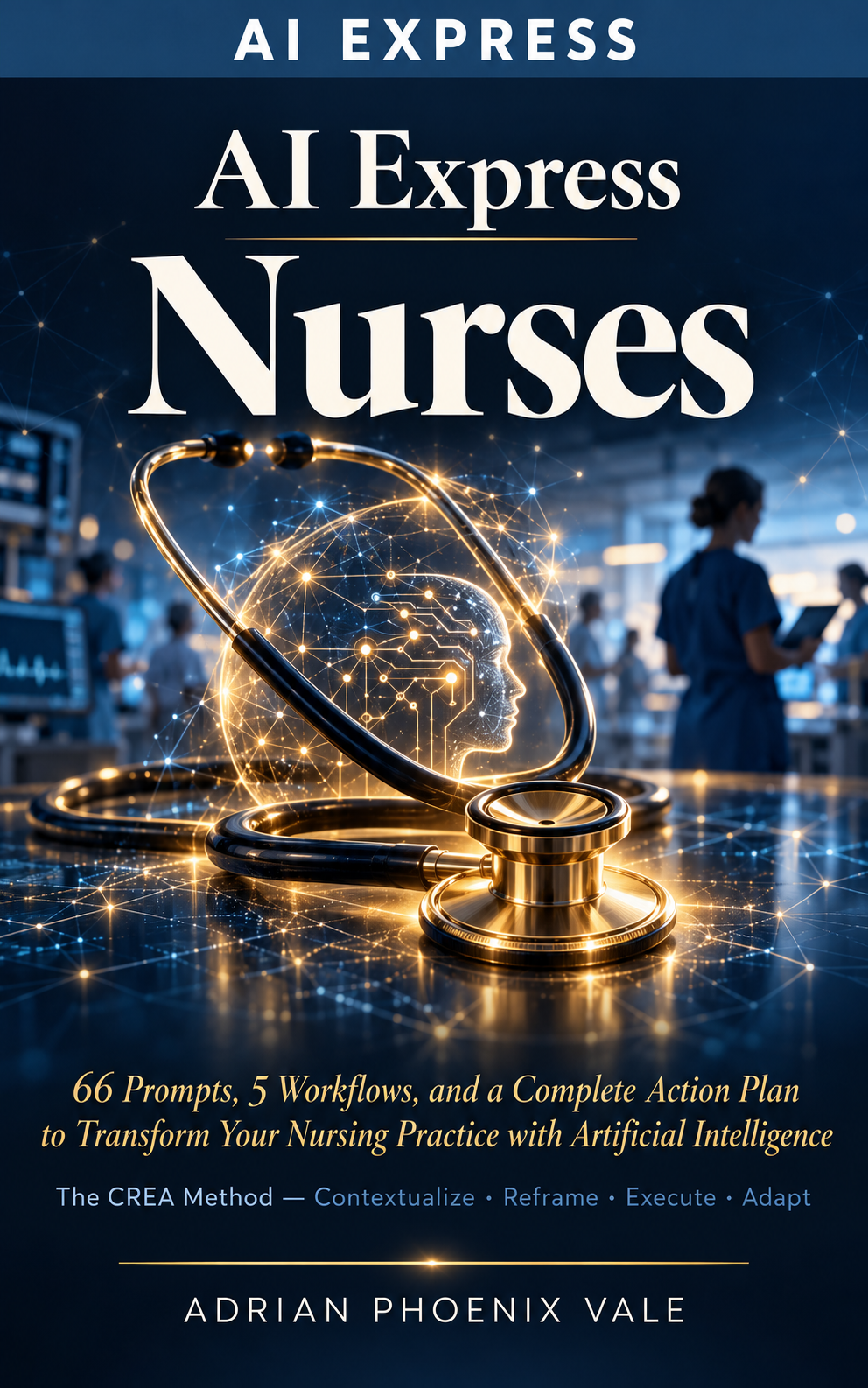
AI Express — Nurses isn't just a clinical tool — it's a career development system. 66 prompts covering documentation, patient care, AND professional advancement. Certification prep. Resume optimization. Negotiation strategy. All in one book.