
Functional Exhaustion:
Why You’re Chronically Tired Despite Normal Blood Tests
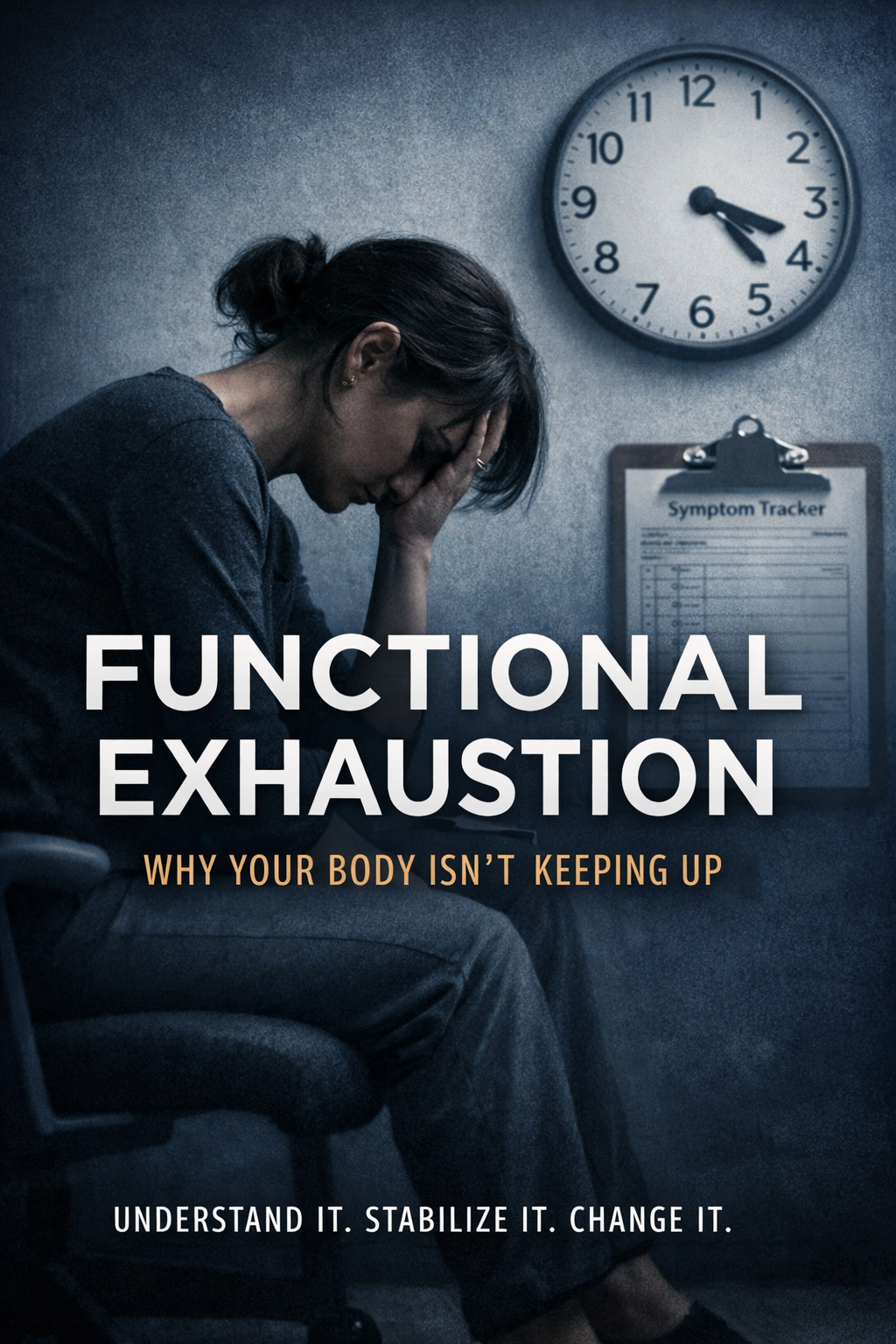
Always Tired, But Tests Are Normal: A Growing Silent Crisis
Millions of people search every month for answers to the same frustrating question:
Why am I always tired but my tests are normal?
Chronic fatigue with normal blood tests — what am I missing?
Is this burnout, depression, or something else?
For many, medical evaluations come back “normal.”
No disease. No deficiency. No clear diagnosis.
Yet the exhaustion remains — persistent, limiting, and often life-altering.
This article explains functional exhaustion: a systemic form of chronic fatigue that standard medicine often fails to describe, measure, or explain.
What Is Functional Exhaustion?
Functional exhaustion is not a lack of motivation, willpower, or resilience.
It is a regulatory shutdown.
The body limits access to energy not because it is broken, but because it is protecting itself from sustained overload.
This distinction matters.
People with functional exhaustion often experience:
chronic tiredness with no clear cause
persistent exhaustion despite normal labs
reduced tolerance to stress, noise, screens, or social interaction
crashes after relatively minor effort
rest that no longer feels restorative
These symptoms don’t point to disease — they point to systemic dysregulation.
👉 For a full system-level explanation, this framework is developed in depth in the ebook
Functional Exhaustion → Why Your Body Is Shutting Down While Medicine Says You’re “Fine”
Why Normal Blood Tests Miss Systemic Collapse
Modern medicine is excellent at detecting disease.
It is far less equipped to detect functional breakdown.
Blood tests measure isolated markers at a single moment in time.
Functional exhaustion develops slowly, across systems:
nervous system regulation
endocrine signaling
metabolic flexibility
immune tone
Each system may appear “within range.”
Together, they no longer function coherently.
This is why chronic exhaustion without diagnosis is so common.
Nothing is technically wrong — yet nothing works.
Burnout vs Depression vs Functional Exhaustion
One of the most damaging confusions is the tendency to collapse everything into one category.
Burnout
Context-dependent
Improves with reduced workload and boundaries
Depression
Primarily affects mood, meaning, reward processing
Functional Exhaustion
Affects regulation
Persists even after rest or lifestyle changes
When exhaustion doesn’t resolve, the real question isn’t burnout or illness.
It’s whether the nervous system has entered permanent defense mode.
Treating these states as interchangeable often prolongs suffering.
Nervous System Dysregulation: The Missing Piece
At the center of functional exhaustion is nervous system dysregulation.
Under chronic stress and insufficient recovery, the nervous system shifts priorities:
safety over performance
conservation over output
predictability over flexibility
Energy becomes restricted by design.
This is why people report:
“Rest doesn’t work anymore.”
“I want to function, but my body won’t respond.”
This is not psychological resistance.
It is physiological protection.
Why Rest Doesn’t Work Anymore
Rest only restores function when the nervous system can enter recovery mode.
In functional exhaustion:
the system remains partially alert
downregulation fails
rest becomes inactivity, not repair
Extended rest can even increase sensitivity.
Recovery requires regulation, not just stopping.
This is why many people searching for why rest doesn’t work anymore find no satisfying answer — until regulation is addressed directly.
Functional Exhaustion Is Not Weakness
This is crucial.
Functional fatigue is not:
laziness
lack of discipline
failure to cope
It is a biological adaptation to chronic overload.
The body slows down deliberately to prevent deeper damage.
Misinterpreting this as weakness leads people to push harder — which reinforces the shutdown.
A Non-Medical Explanation — Without Anti-Medicine Rhetoric
Functional exhaustion exists between medical specialties.
It is not imaginary.
It is not alternative.
It simply doesn’t fit a disease-based diagnostic model.
A non-medical explanation of fatigue does not mean rejecting healthcare.
It means understanding the limits of current frameworks.
This perspective restores something essential: self-trust.
Stabilization Comes Before Recovery
The biggest mistake people make is trying to “recover” too early.
In functional exhaustion:
recovery attempts destabilize
pushing triggers crashes
motivation backfires
The first goal is stabilization:
fewer crashes
predictable limits
reduced volatility
Only then can capacity rebuild — slowly, safely, without violence.
This principle is central to practical recovery from exhaustion.
A Rational Path Forward
Functional exhaustion does not resolve dramatically.
Improvement shows up quietly:
faster recovery
wider tolerance
fewer surprises
less internal resistance
This path is not inspirational.
It is effective.
And for people living with chronic exhaustion recovery, effectiveness matters more than motivation.
When You Need the Full Framework
This article outlines the logic.
The complete system — mechanisms, distinctions, and practical principles — is developed in the ebook:
👉 Functional Exhaustion → Why Your Body Is Shutting Down While Medicine Says You’re “Fine”
It is designed for:
people exhausted despite normal tests
readers who want explanation, not hype
those ready to stop forcing recovery
Final Thought
If you are always tired for no clear reason,
if tests are normal but capacity keeps shrinking,
the problem is not that nothing is happening.
It’s that what is happening has never been clearly explained.
Functional exhaustion gives that explanation — without blame, without false promises, and without violence.
FAQ — Functional Exhaustion
1) What is functional exhaustion?
Functional exhaustion is a state where the body restricts capacity for protection. It’s not simply “low energy”—it’s a regulation problem across multiple systems.
2) Why am I exhausted all the time but blood tests are normal?
Standard tests often detect disease thresholds, not regulation breakdown. You can be within “normal ranges” while the system is still operating in chronic defense mode.
3) Is functional exhaustion the same as burnout?
Not necessarily. Burnout is often situation-linked and may improve with reduced demands. Functional exhaustion tends to persist even after rest, because regulation remains impaired.
4) Is this depression?
Depression can include fatigue, but functional exhaustion is centered on reduced physiological tolerance (stimulation, effort, recovery). They can overlap, but they aren’t the same pattern.
5) Why doesn’t rest work anymore?
Rest restores function only if the nervous system can downshift into recovery. In functional exhaustion, the system may stay partially “on guard,” making rest feel flat or ineffective.
6) What does “nervous system dysregulation” mean in plain terms?
It means the body’s “safety + recovery controls” are stuck in protection mode. The system reduces output and tolerance to avoid further overload.
7) What’s the biggest mistake people make when trying to recover?
Trying to force recovery too early—pushing, optimizing, testing limits—often increases crashes because the system interprets it as threat.
8) What’s the first step if I suspect functional exhaustion?
Stabilization: reduce volatility, lower unpredictability, and stop the cycle of push → crash → longer recovery. Capacity comes later.
9) Is this medical advice?
No. This content is educational and informational. If symptoms are severe, persistent, or worsening, it’s important to consult a qualified healthcare professional.
10) Where can I get the full framework (not just the overview)?
The full system-level framework is in the ebook Functional Exhaustion (including stabilization principles, mistakes to avoid, and capacity rebuilding):