
Why You Feel Unsteady After 60
and the Simple At-Home Plan to Rebuild Balance, Confidence, and Independence
If you have not fallen, you may think your balance is fine.
But that is not always how it works.
For many adults over 60, balance problems do not begin with a dramatic fall. They begin with small changes that feel easy to dismiss. You stand up more slowly. You reach for a wall without thinking. You feel less confident on stairs. You watch the ground more carefully than before.
None of this feels urgent.
And that is exactly why it matters.
More than 1 in 4 older adults fall each year, and falling once doubles the chance of falling again. Falls are also the leading cause of injury for adults 65 and older.
The good news is that falls are not a normal part of aging, and there are practical steps that can help reduce risk and improve stability. Recent U.S. recommendations support exercise interventions for older adults at increased risk, while organizations focused on healthy aging also emphasize home safety, health checkups, and confidence-building strategies.
This article will show you why balance often declines quietly, what warning signs to watch for, and what you can start doing at home to walk more confidently and stay independent longer.
Why balance often gets worse before anyone notices
Most people think balance loss is sudden.
It usually is not.
What changes first is often subtle:
your reactions get a little slower,
your movements become more cautious,
your confidence drops,
and your body starts compensating.
That compensation can look like “being careful,” but it often means your system is already adapting to instability.
This matters because balance is not just about leg strength. It depends on several systems working together:
your muscles,
your vision,
your inner sense of body position,
your attention,
and your brain’s ability to make fast adjustments.
That is one reason expert guidance on falls prevention does not focus only on one factor. The strongest public-health advice combines exercise with attention to home safety, medication effects, and other individual risk factors.
The quiet warning signs many people ignore
You do not need a major incident to take balance seriously.
These small signs count:
needing your hands to stand up
feeling hesitant while walking
relying more on railings or furniture
slowing down before turning
feeling slightly unstable while standing still
These signs do not mean you are “fragile.”
They mean your body is asking for support before the problem gets bigger.
The earlier you act, the easier it is to improve.
The real fear is not just falling
For many people, the hardest part is not the fall itself.
It is what starts happening before or after:
moving less,
avoiding certain places,
losing confidence,
and slowly giving up parts of daily life.
That pattern is well recognized in evidence-based fall prevention programs. For example, the National Council on Aging highlights “A Matter of Balance,” a program specifically designed to reduce fear of falling and improve activity levels in older adults.
That is why the best balance plan is not just physical.
It must also help you feel safer, calmer, and more in control.
Why exercise is one of the most powerful tools
Exercise is not about pushing hard.
It is about helping your body relearn stability.
The U.S. Preventive Services Task Force recommends exercise interventions for community-dwelling adults 65 and older who are at increased risk for falls. That matters because it confirms something simple but powerful: movement, when done the right way, is not dangerous by default. It is often part of the solution.
The key is choosing movements that are:
simple
repeatable
safe at home
realistic for daily life
That is where many seniors get stuck. They do not need an intense workout plan. They need a clear, manageable routine they can actually follow.
The 4 mistakes that quietly make balance worse
1. Moving less to “stay safe”
This feels logical, but less movement often means less coordination and less confidence.
2. Rushing everyday motions
Standing up too fast, turning too quickly, or walking while distracted can increase instability.
3. Ignoring fatigue
When you are tired, your reactions and focus can drop. That makes balance less reliable.
4. Assuming it is “just age”
Aging changes the body, but instability is not something you must simply accept. Falls can be prevented, and risk can be lowered.
A simple 2-minute balance check you can do at home
You do not need equipment to start paying attention.
Try these four quick checks near a stable support:
stand still for 10 seconds and notice if you sway
stand up from a chair without using your hands if safe to do so
walk a few steps while looking forward, not down
turn around slowly and notice whether you feel steady
These are not medical tests.
They are awareness tools.
If any of these feel harder than they should, that is not a reason to panic.
It is a reason to act early.
The home changes that can reduce risk right away
Sometimes the problem is not only your body.
It is your environment.
Public-health guidance consistently points to home hazards and broader multifactorial risks as important parts of falls prevention. That includes clutter, poor lighting, and unstable support points around the home.
Start with:
removing loose rugs
clearing walkways
improving lighting, especially at night
checking that chairs, tables, and support points are stable
making the bathroom safer with non-slip surfaces and reliable support
These changes are simple, but they can make a real difference immediately.
The brain–confidence–balance connection most people miss
Balance is not only physical.
Your brain constantly processes what your eyes see, how your feet feel on the ground, and how your body is moving through space. As these systems become less efficient or confidence drops, movement can become more rigid and less natural.
Fear of falling can make this worse.
When people feel afraid, they often tense up, shorten their steps, move less naturally, and trust their body less. That can create a cycle:
less confidence,
stiffer movement,
worse balance,
more fear.
This is exactly why an effective plan should not only strengthen the body. It should also rebuild trust in movement.
The best kind of balance plan is simple enough to repeat
The most useful plan is not the most complicated one.
It is the one you can do consistently.
That means:
a few minutes a day
no equipment
realistic home-based practice
clear progress from awareness to confidence
This is especially important for a global English-speaking audience, because the same need appears across countries: older adults want something simple, safe, affordable, and doable at home.
They want to stay independent.
They want to walk without fear.
They want to keep their freedom.
If you feel less steady after 60, start before a fall happens
You do not have to wait for something serious.
You do not have to “earn” the right to care about your balance.
If you already feel:
slightly unsteady
more cautious than before
less confident outdoors
more dependent on support
that is enough reason to start.
The earlier you begin, the more likely it is that simple actions will help.
A practical next step you can take today
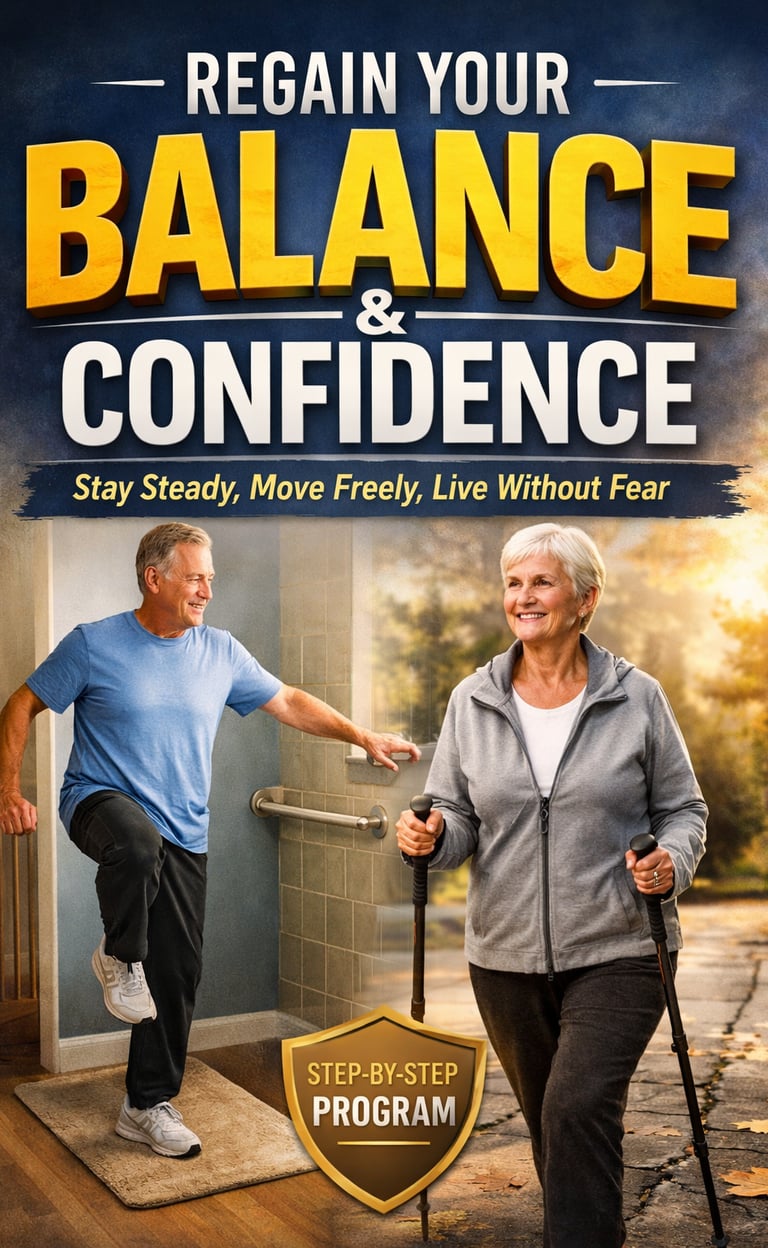
If you want a clear, step-by-step system you can follow at home, this guide is built exactly for that.
It walks you through:
the warning signs to watch for
a simple self-test
a 21-day reset protocol
home safety improvements
the link between your brain, confidence, and stability
how to walk outside with more confidence again
You can get it here: Rebuild your balance and confidence
Final thought
Balance is not only about avoiding a fall.
It is about protecting independence.
It is about walking through your home without hesitation.
Going outside without fear.
Trusting your body again.
And in many cases, that process starts with something very small:
paying attention early,
making simple adjustments,
and taking a few minutes a day to rebuild what your body is asking for.
If that is where you are right now, start now, not later.
Because staying steady is not just about safety.
It is about freedom.